
End-to-end quantum estimation of pseudospectra for non-Hermitian quantum many-body systems
 While standard quantum mechanics usually plays by "Hermitian" rules, where energy is real and probability is conserved, the real world is often much messier. Open quantum systems, which interact with their environments through the gain and loss of energy and particles, require a non-Hermitian description.
The new paper "Towards End-to-End Quantum Estimation of Non-Hermitian Pseudospectra" (arXiv:2603.16214) by QLab Fellow Xiaodi Wu, alongside Gengzhi Yang, Jiaqi (Jimmy) Leng, and Lin Lin, introduces a powerful new framework to assess the spectrum of open quantum many-body systems.
The Challenge of Spectral Instability
In non-Hermitian systems, the spectrum (the set of eigenvalues) is fragile. Even a microscopic perturbation can cause the eigenvalues to jump or shift dramatically. To navigate this, the research team turned their attention to the pseudospectrum - a more robust set of values (based on a norm bound of the resolvent) that captures the system's behavior even under noise. The team provides a rigorous theoretical foundation for this approach:
- They prove that determining membership in a spectrum for non-Hermitian local Hamiltonians can be, somewhat surprisingly, PSPACE-hard in the worst case, meaning that the problem requires a memory amount that is, at most, a polynomial of the input size, but can demand an exponential amount of time to solve.
- In contrast, determining membership in a pseudo-spectrum turns out to be a QMA-complete problem. QMA (Quantum Merlin-Arthur) is a quantum analog of the classical complexity class NP. It represents the set of decision problems for which a "yes" answer can be verified in polynomial time by a quantum computer with the help of a quantum proof or witness. A QMA-complete problem is in QMA and any other problem in QMA can be reduced to it in polynomial time.
This puts pseudospectrum estimation in the same category as the famous local Hamiltonian problem (determining the groundstate energy of a 2-local or 3-local Hermitian quantum system), establishing it as a natural "computational target" where quantum computers can offer a clear advantage over classical ones.
Two Major Algorithmic Innovations
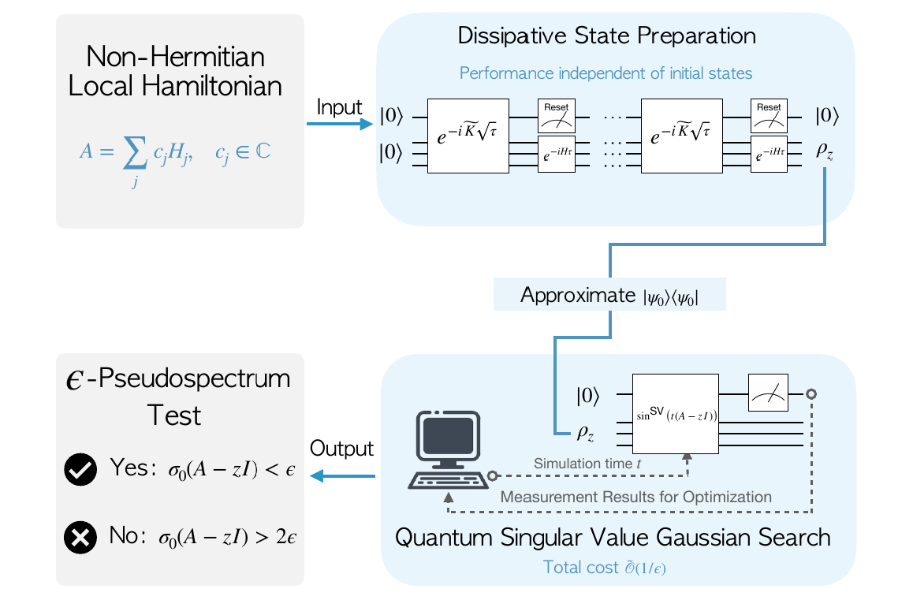
The paper details an end-to-end pipeline for pseudospectrum estimation supported by two core technological advances:
- QSIGS (quantum singular-value Gaussian-filtered search): This algorithm acts as a high-precision "filter." By combining quantum singular value transformation (QSVT) - the Swiss army knife of quantum algorithms - with classical post-processing, the team achieves Heisenberg-limited scaling. This means the algorithm is as resource-efficient as physically possible for singular-value estimation.
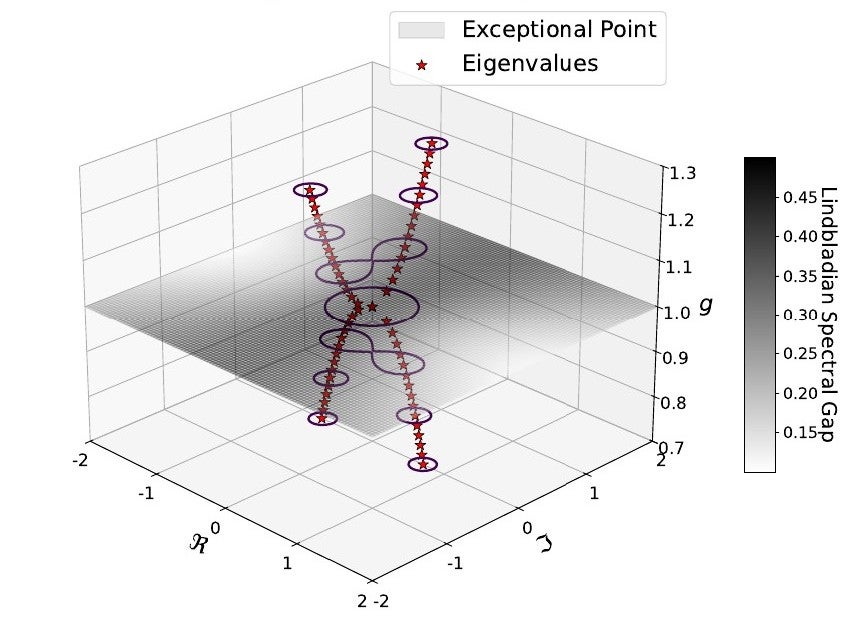
- Algorithmic Lindbladian protocols: Preparing the right starting state is half the battle. The team developed a dissipative state preparation technique to find approximate ground right singular vectors. They demonstrated its effectiveness for the Hatano-Nelson model, a classic benchmark for non-Hermitian systems.
 Demonstration on IonQ Forte
Moving beyond theory, the researchers successfully demonstrated the entire protocol on IonQ Forte, a state-of-the-art trapped-ion quantum computer. The experiment focused on a non-Hermitian qubit model near its "exceptional point" - a unique feature of non-Hermitian physics where eigenvalues and their corresponding eigenvectors coalesce. The quantum hardware was able to successfully distinguish points within the pseudospectrum.