
2026 Meeting of the National Quantum Laboratory - Exciting results and projects
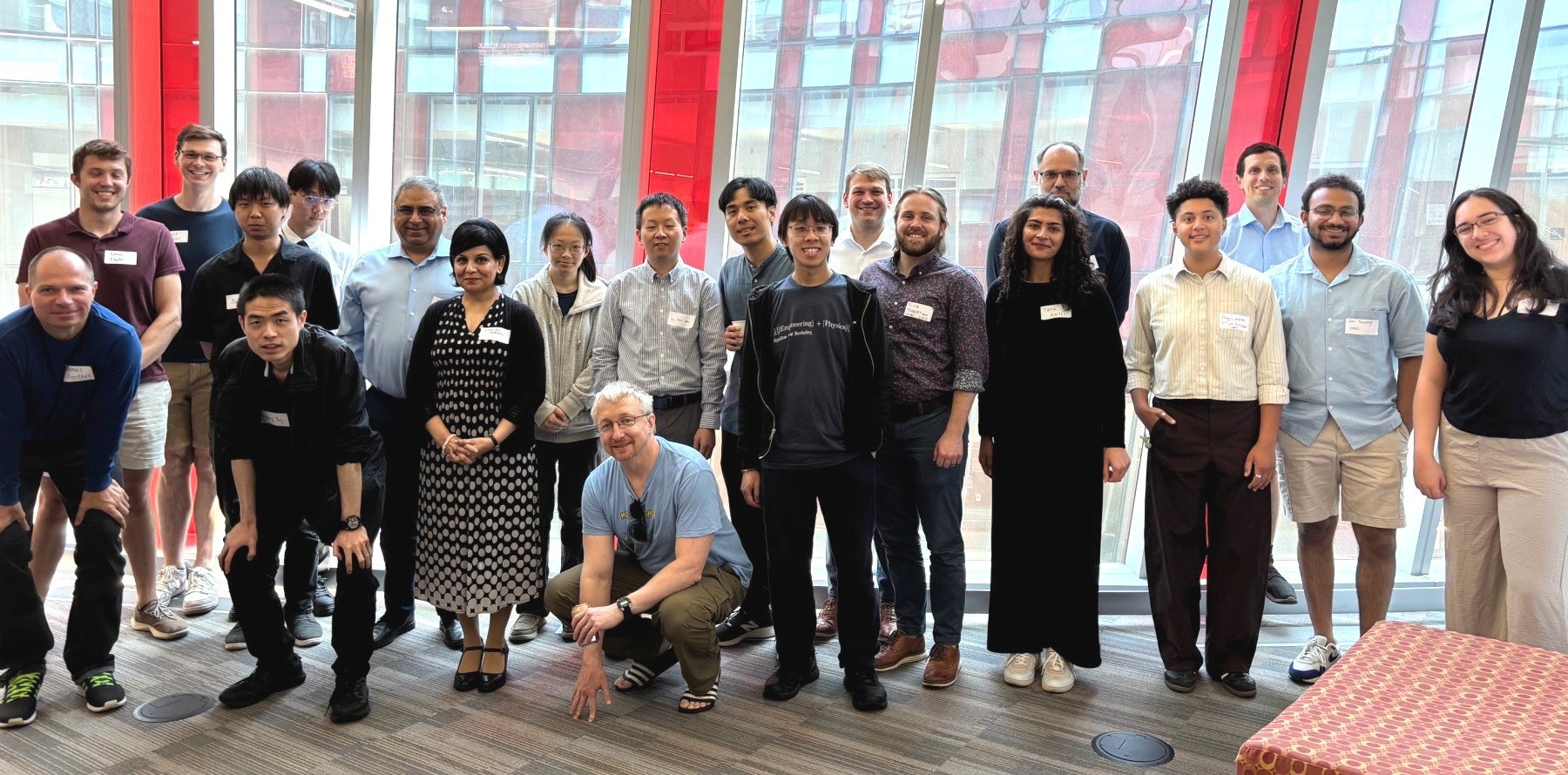
Yesterday, the 2026 Meeting of the National Quantum Laboratory (QLab) took place at the UMD Physical Sciences Complex, bringing together the Maryland quantum community and discussing cutting-edge work on practical quantum computation.
The meeting featured a 12 talks by young quantum physicists, covering a wide array of topics from quantum simulation to machine learning and error mitigation. A massive thank you to the amazing participants who joined and shared their exciting projects, including the groups of Sebastian Deffner, Shabnam Jabeen, Alexey Gorshkov, Xiaodi Wu, Tian Lan, Avik Dutt, Thomas Barthel, Alaina Green and Norbert Linke, as well as BosonQ Pis's Alex Khan. Fostering this kind of cross-disciplinary collaboration is exactly what the QLab ecosystem is all about!
QLab Director Norbert Linke led discussions focused on expanded quantum computing access for the research community and previewed upcoming events to further integrate QLab's capabilities with user needs and spread knowledge about quantum information technology through outreach activities.
The scientific program featured the following projects at the frontier of practical quantum computation and simulation:
1. Error Mitigation & Quantum Error Correction
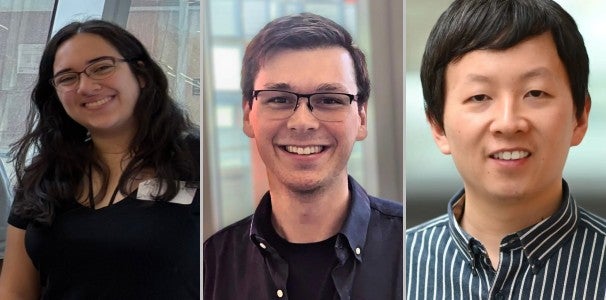 Diana Munoz-Valencia talked about Holographic codes, exploring the landscape of holographic quantum error-correcting codes and their deep connections to the AdS/CFT correspondence. Diana also reported on improved workflows to achieve peak-performance on IonQ quantum computers.
- Thomas Steckmann demonstrated Error mitigation with QuEra, introducing a novel zero-noise extrapolation technique designed to effectively suppress shot-to-shot fluctuations in Hamiltonians on platforms like Rydberg atom arrays and trapped ions.
- Zhiyuan Wei reported on Probing 2D error-mitigation thresholds with noisy random circuits, presenting numerical evidence for critical thresholds where error mitigation techniques become effective in two-dimensional quantum circuits.
2. Quantum Simulation & Dynamics
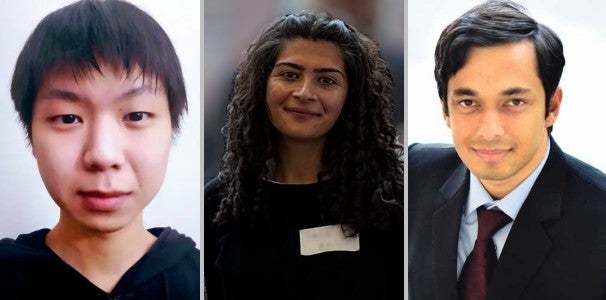 Joseph Li reported on exciting results concerning the Resource-efficient quantum simulation of transport via Hamiltonian embedding. He presented a comprehensive framework using Hamiltonian embedding to simulate transport equations, achieving significant reductions in circuit depth and demonstrating a 2D advection equation on trapped-ion hardware. [arXiv:2602.03099]
- Tara Kalsi discussed ideas about Deterministically replicating monitored dynamics in real time on quantum computers. The intriguing challenge is to prepare identical copies of states arising in the dynamics of open quantum systems under continuous measurement and decoherence, which would, for example, give access to Rényi entanglement entropies in such states.
- Avik Dutt described Digital quantum simulation using compact encoding and optimized circuits on IonQ's QPUs, demonstrating algorithm-hardware co-design strategies, including iteratively preconditioned gradient descent, to dramatically reduce 2-qubit gate counts for simulating the Fermi-Hubbard model. [arXiv:2411.07778]
3. State Preparation & Fundamental Quantum Benchmarks
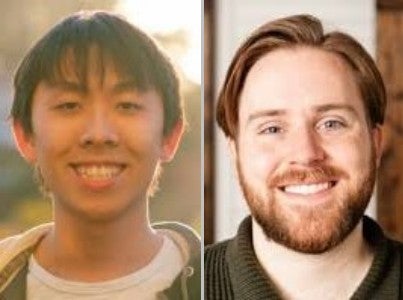 Anton Than presented Nonlocal quantum games, showcasing how quantum entanglement makes it possible to surpass classical mathematical limits in graph coloring puzzles and using these quantum games as device-independent benchmarks to assess the performance of various quantum computers. [arXiv:2603.18323]
- Reece Robertson demonstrated Variational Gibbs state preparation on trapped-ion devices, describing the implementation of a variational algorithm on IonQ hardware to prepare thermal states of the Ising model by minimization of the Helmholtz free energy. [arXiv:2603.03801]
4. Quantum Machine Learning (QML)
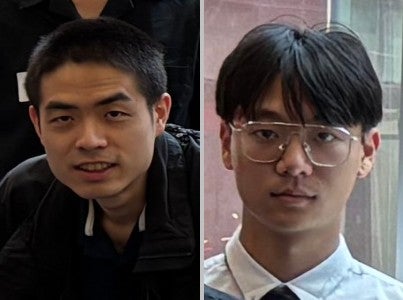 Jinghong Yang talked about Quantum machine learning and quantum simulation. He presented a practical scheme for quantum state tomography using quantum machine learning on classical measurement data. [arXiv:2507.01246]
Jinghong also introduced Monte Carlo-assisted methods to tighten truncation bounds for boson systems to reduce errors in simulations of quantum field theories. [arxiv:2604.24896]- Haishi Huang showcased Quantum machine learning for brain tumor oncology, demonstrating how quantum neural networks and hybrid algorithms can be utilized for advanced medical image analysis and oncology diagnostics.
5. State Characterization, Tomography, & Sensing
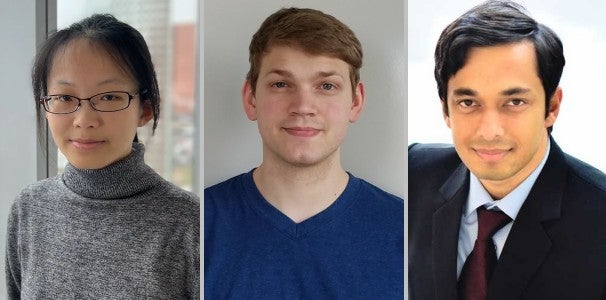
Yuxin Wang discussed the central task of Noise sensing, showing how entanglement provides an exponential sensitivity advantage in sensing correlated noise as quantified via quantum Fisher information of the sensor state. [arXiv:2410.05878]
- Josey Stevens introduced the idea of Procrustes tomography, guiding the audience through the mathematical intricacies of this novel robust method for accurate quantum state and quantum process characterization.
- Avik Dutt gave an overview on Quantum photonics and squeezed light for sensing and analog Hamiltonian simulation, describing the generation of multimode squeezed light and quantum dispersive waves using nanophotonic chips, which paves the way for enhanced continuous-variable entanglement. [arXiv:2505.03734 & arXiv:2605.03995]
QLab looks forward to continue supporting young quantum scientists and elevating breakthroughs in quantum information science.