
QLab researchers pioneer highly efficient parallel entangling gates for trapped-ion computers
An important bottleneck in quantum computing is the time it takes to execute complex algorithms. Executing quantum gates in series significantly increases circuit depth and leaves fragile quantum states vulnerable to decoherence. While running operations in parallel is a clear solution, doing so on trapped-ion architectures has historically presented substantial challenges in classical control and gate calibration.
Now, a team of researchers from the Joint Quantum Institute, ApexQuantum Inc., and the National Quantum Laboratory (QLab) at UMD has demonstrated a new method for executing entangling gates in parallel. The paper "Arbitrary parallel entangling gates with independent calibration on a trapped ion quantum computer" (arXiv:2604.25993), introduces a highly scalable pulse-synthesis framework that eliminates the need to custom-design laser pulses for every new circuit pattern.
The Core Innovation: Canceling Crosstalk to Enable Independent Calibration
 In a fully connected trapped-ion system of $N$ qubits, there are $O(N^2)$ possible two-qubit pairings. Because each pair can either be entangled or left idle, there are $2^{O(N^2)}$ possible parallel gate patterns.
Previously, researchers had to use computationally heavy algorithms to synthesize a bespoke set of laser pulses for each specific pattern. Furthermore, whenever the machine drifted, these highly specific patterns were notoriously difficult to calibrate because tuning one pulse would inadvertently affect the others.
The team solved this by effectively separating the gate pulses into different frequency bands, grossly minimizing the crosstalk terms between them, and fully suppress the remaining crosstalk with a simple iterative method:
- Increased Efficiency: With this scheme, only $O(N^2)$ gate pulses are sufficient to support the $2^{O(N^2)}$ possible two-qubit entangling gate patterns. This eliminates the need for tailor-made pulse synthesis for every new pattern — significantly reducing classical control complexity!
- Independent Calibration: Because these gate pulses can be individually and independently calibrated, it promises to significantly improve the operational uptime of trapped-ion systems. This also bypasses the need for large memory storage on FPGA boards.
Algorithm Speedups and Real-World Tradeoffs
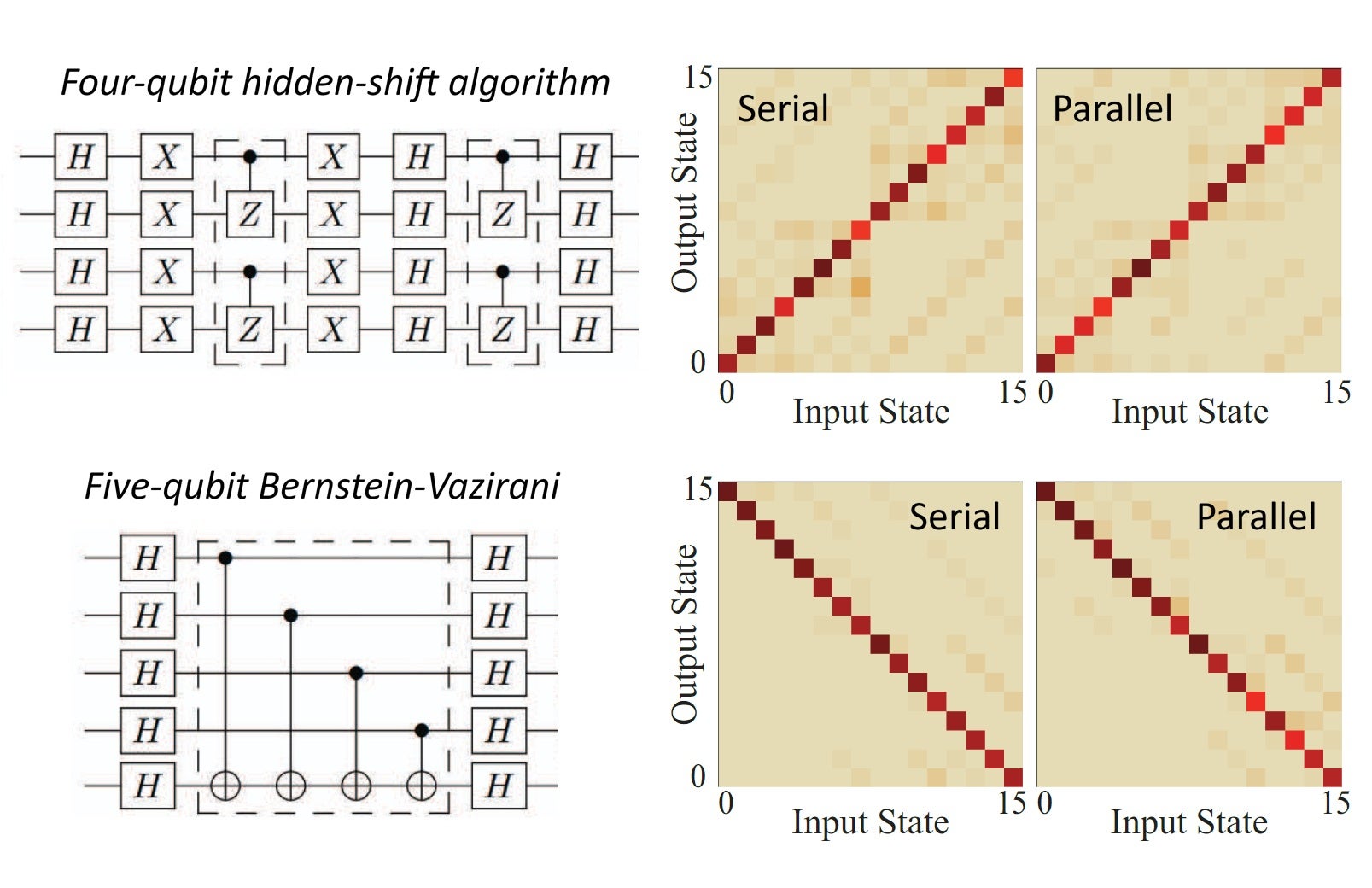
To benchmark the new method, the team ran three well-known quantum routines on an ion-trap quantum computer with and without the new parallelization scheme: the hidden-shift algorithm, Bernstein-Vazirani algorithm, and a Heisenberg Hamiltonian simulation (using disjoint, star, and ring graphs).
The parallel implementations yield significant reductions in total execution time with uncompromised fidelity. For disjoint qubit pairs (where no two gates share the same ion), the execution time was comparable to running a single gate, achieving a near-linear speedup. For example, the parallel HS implementation achieved an average fidelity of 94.58%, completely comparable to the 93.15% fidelity of the serial version, but in roughly half the time.
The researchers also discuss physical limitations of parallelization:
- When multiple gates overlap on a single central qubit (a "star" or fan-in/fan-out graph), they cannot all be driven at maximum laser power without exceeding hardware limits. The team utilized a "power rebalancing" technique, resulting in an execution speedup of $O(\sqrt{d})$ instead of a full linear speedup, where $d$ is the number of overlapping gates.
- Parallel gate durations cannot be extended indefinitely to make up for lower power. The system's motional coherence time sets a limit.
- The method scales exceptionally well for medium-length ion chains. However, for chains larger than $N=35$, the motional mode frequencies become more crowded, requiring a spike in laser power to accurately target specific modes. This strongly motivates future architectures featuring multiple medium-length ion chains
Congratulations to the authors: Matthew Diaz, Masoud Mohammadi-Arzanagh, Yingyue Zhu, Mohammad Hafezi, Norbert M. Linke, Alaina M. Green, and Arthur Y. Nam!