
From quantum error correction to emergent gravity: Probing holographic universes at QLab
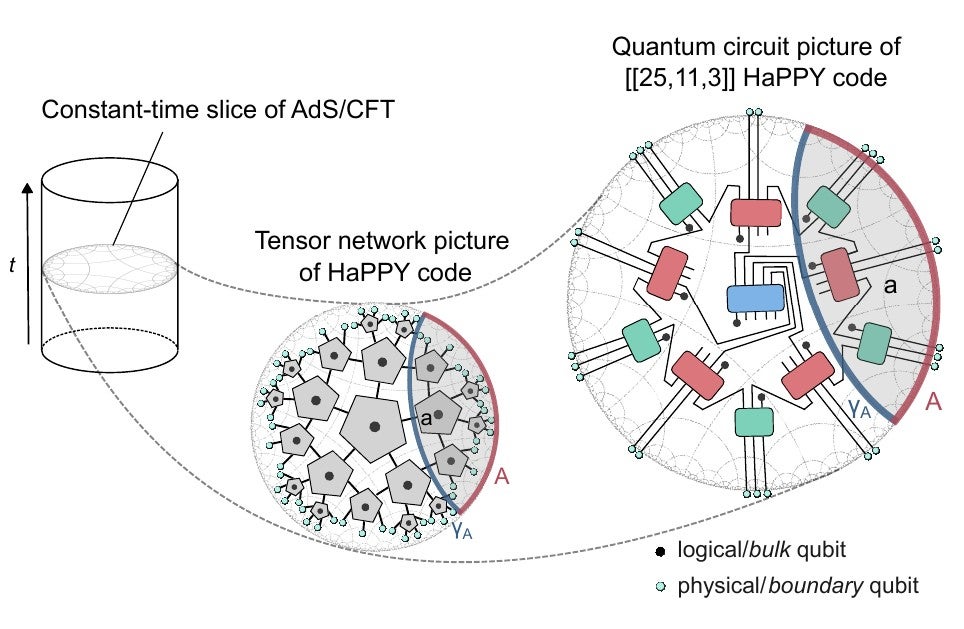 One of the deepest ambitions in modern physics is understanding how the fabric of space and time could emerge from fundamental quantum degrees of freedom to establish a quantum theory of gravity. In the new paper "Observation of gravity-like signatures in holographic codes on a quantum computer," researchers from the National Quantum Laboratory (QLab@UMD), the Duke Quantum Center, the Virginia Tech Center for Quantum Information Science and Engineering, Caltech's Institute for Quantum Information and Matter, IonQ, and BlueQubit have successfully simulated toy models of quantum gravity according to the AdS/CFT correspondence. The team, led by Crystal Noel and Charles Cao, includes the quantum-computation pioneers John Preskill and Christopher Monroe.
Using the IonQ Forte ion-trap quantum computer, the study implements the intriguing HaPPY quantum error-correction code, which forms a bridge between quantum computing and quantum gravity. This code simulates a (highly simplified) model of a universe with a negative cosmological constant that features a so-called bulk boundary correspondence, where the properties of a higher-dimensional gravitational universe (bulk) are completely determined by a lower-dimensional quantum system without gravity, living on the boundary. The team successfully demonstrated fundamental entanglement properties of these systems.
The theoretical bedrock: What is AdS/CFT?
To understand the experiment, it helps to explore the framework of the anti-de Sitter / conformal field theory (AdS/CFT) correspondence, which is so far the most successful realization of the holographic principle, an idea in quantum gravity originally proposed by Gerard 't Hooft and promoted by Leonard Susskind.
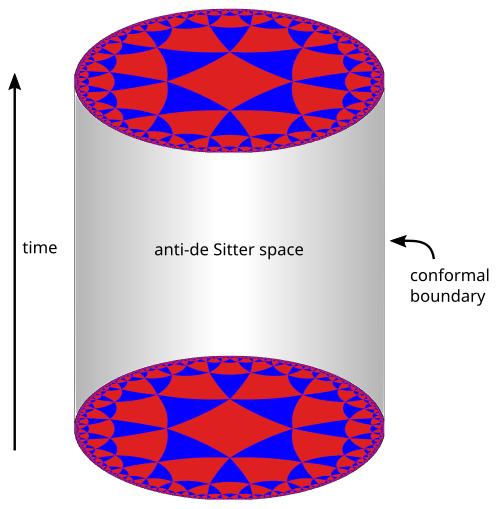
Imagine a solid soup can. The inside of the can (the "bulk") contains a universe governed by gravity and a warped spacetime geometric backdrop called anti-de Sitter space (AdS). Here, the "anti" refers to a negative cosmological constant ($\Lambda < 0$), corresponding to an attractive gravitational pressure which tries to pull space back inward, while our actual universe is characterized by a positive cosmological constant ($\Lambda > 0$), corresponding to a repulsive gravitational pressure which leads to an accelerating expansion of the universe. A funny feature of AdS is the "thermos" effect: If you shine a flashlight in AdS, the light beam will actually curve, reach the boundary of the universe in a finite amount of time, and bounce back to you as in a reflective containment vessel.
Meanwhile, the flat labels on the outside of the can (the "boundary") contain a lower-dimensional system of quantum particles that has no gravity at all. In the case of AdS/CFT, this is a highly symmetric conformal field theory (CFT), which is invariant under conformal transformations of spacetime, comprising all angle-preserving transformations like translations, rotations, and stretching.
The AdS/CFT correspondence was first proposed by Juan Maldacena in 1997. It establishes that the described bulk and boundary systems are mathematically equivalent descriptions of the exact same physics! Everything happening inside the bulk universe - including the path of a particle warped by space - is perfectly encoded in the complex quantum entanglement patterns of the particles sitting on the boundary surface. Essentially, space and gravity on the inside can be thought of as a holographic projection emerging directly from the entanglement on the outside.
Connection to quantum error correction: The HaPPY code
How do physicists model a continuous universe inside a finite, digital quantum computer? In this study, the researchers used a beautiful connection to a special type of quantum error-correcting code.
To protect quantum information against environmental noise (decoherence), physicists encode each piece of information - a "logical" qubit - into a highly entangled state spread across many physical qubits. Because the information is encoded in a redundant, distributed way, the system can suffer local damage (like a physical qubit losing its state) without losing the overarching logical information, allowing for correction if errors are not too frequent.
Remarkably, this computer science concept is also realized by the AdS/CFT correspondence. In this framework, recovering physical events and information encoded deep inside the gravitational bulk from the boundary is fundamentally the same mathematical process as recovering a logical qubit from a network of (perturbed) physical qubits.
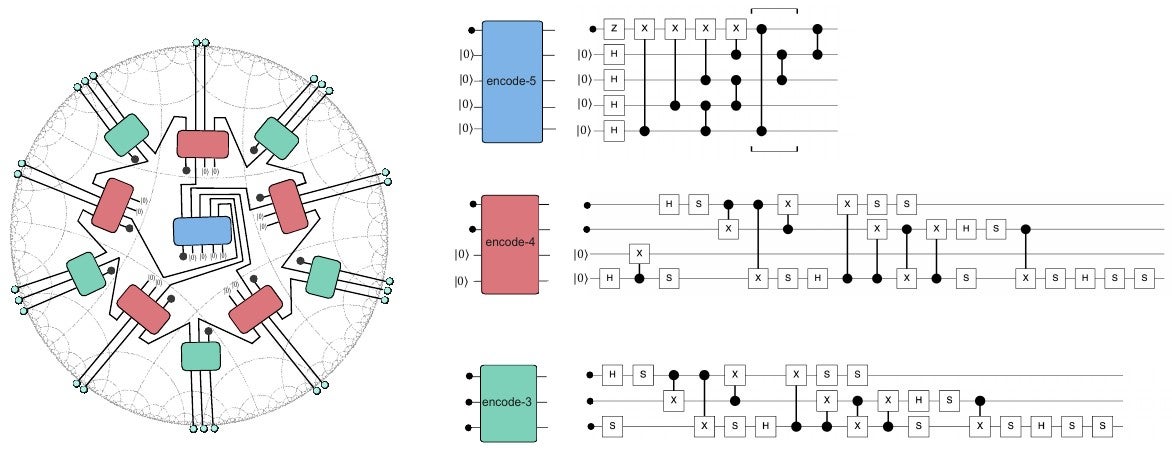
To study the duality in finite quantum systems, researchers use holographic error-correcting codes, with the paradigmatic example being the HaPPY code, named after its creators Harlow, Pastawski, Preskill, and Yoshida. The HaPPY code is constructed using a network of "perfect" tensors, tiling a hyperbolic space to represent a slice of the AdS universe. By mapping logical bulk qubits situated inside this network to physical boundary qubits on its outer edge, the HaPPY code natively reproduces key features of the holographic dictionary. Most notably, it obeys the Ryu-Takayanagi formula, relating geometric areas in the gravitational bulk to quantum entanglement on the boundary.
Let's say noise or an adversary corrupts a massive chunk of the physical qubits on the boundary of the HaPPY code (erasure error). In a "greedy" algorithm, we can then start at the remaining uncorrupted boundary qubits. If a set of working boundary qubits is connected to one of the perfect tensors inside the network, it can use the mathematical properties of that tensor to "shoot" inward, reclaiming the logical space just behind it. As long as the corrupted boundary region is small enough, the algorithm can push all the way to the center, completely bypassing the error and reconstructing the logical qubits.
Experimental milestone: Testing the Faulkner-Lewkowycz-Maldacena formula
A major entry in the holographic dictionary is the Ryu-Takayanagi formula, and its quantum-refined successor, the Faulkner-Lewkowycz-Maldacena formula. These equations state that the entanglement entropy (a measure of quantum information) of a region $A$ on the boundary is directly proportional to a corresponding minimal-area surface $\gamma_A$ in the bulk (like a soap film stretching into the bulk) plus the entropy of any quantum matter residing in the bulk volume enclosed by $A$ and $\gamma_A$:
$$S(A)_{Boundary} = \frac{\text{Area}(\gamma_A)}{4G_N} + S_{Bulk}$$
Using the IonQ Forte quantum computer, the researchers compiled the layers of a HaPPY code into highly optimized gate sequences. Systematically varying the entanglement ($\theta$) of the simulated bulk qubits, the researchers performed full quantum state tomography to extract the resulting entropies. They confirmed for the first time experimentally that, as the bulk matter grew more entangled, the boundary entropy increased in perfect lockstep, leaving the calculated geometric area term perfectly constant - exactly as the FLM formula predicts for a stable background space.
Injecting "magic" to simulate space distortions
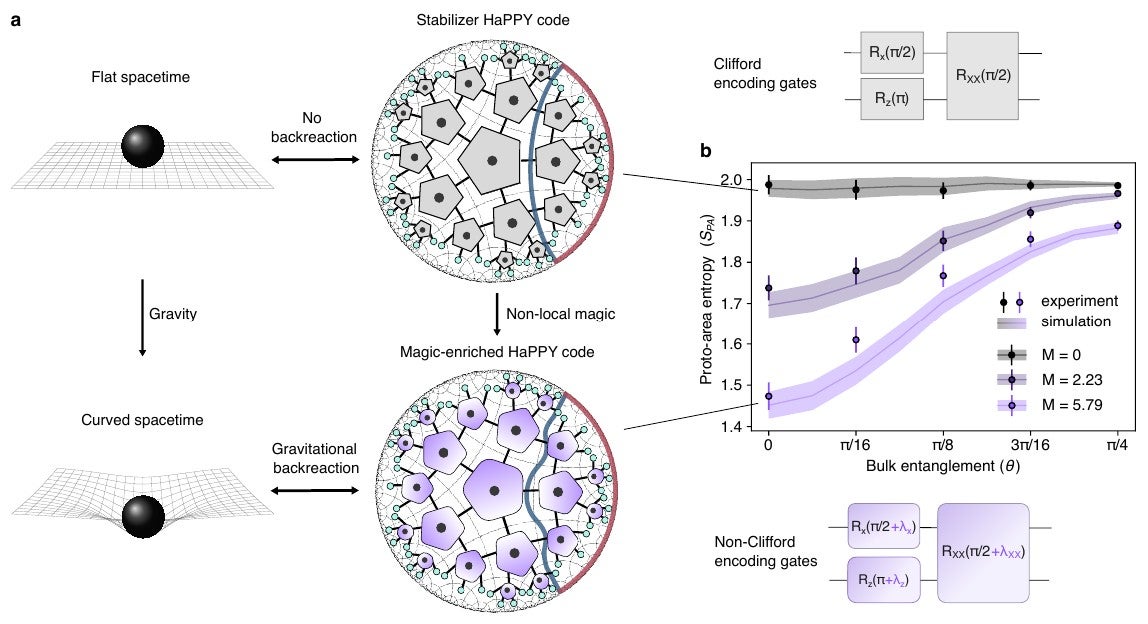
While the standard HaPPY code acts like a rigid background, actual gravity is dynamic: matter possesses mass and energy that physically warps the geometry of spacetime (gravitational backreaction). Because the standard HaPPY code is built out of basic Clifford gates, its geometry is entirely rigid and incapable of reacting to changes in matter states.
To introduce an analog of this warping, the team injected non-stabilizer resources - known in quantum information science as "magic." By adding deliberate over- and under-rotations to the quantum gates, the circuit was shifted away from its rigid Clifford constraints.
With magic active, the team measured the proto-area entropy (the difference between boundary and bulk entropies). Remarkably, they observed that the geometric area term was no longer static; instead, it grew as the bulk qubits became more entangled. This is analogous to a gravitational system where the presence of quantum matter alters the surrounding emergent geometry.
Exploring multi-system connectivity
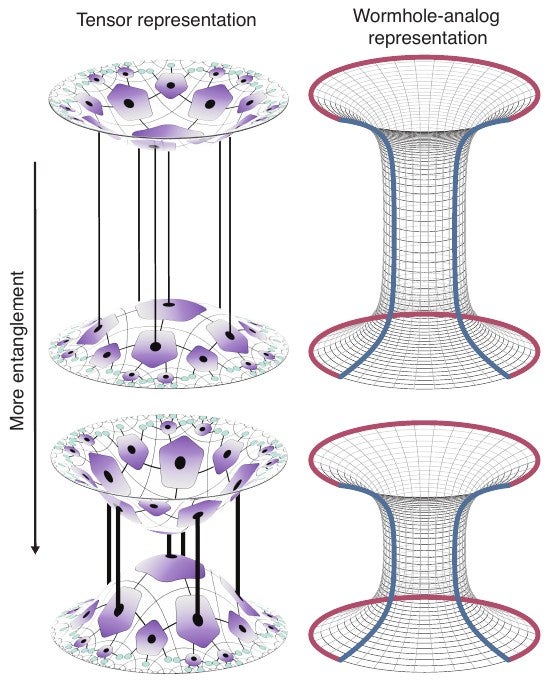
Finally, the researchers pushed the code boundaries into a double-sided configuration by entangling the logical bulk degrees of freedom across two entirely independent copies of the magic-enriched HaPPY code.
According to the famous ER=EPR conjecture pioneered by Maldacena and Susskind, entangling two black holes creates a physical wormhole bridge connecting their spacetimes. In this exploratory circuit setup, the researchers observed the exact opposite trend of the single-copy code: as the entanglement between the two separate code blocks was turned up, the measured proto-area entropy decreased. In holographic language, this drop in entropy is qualitatively reminiscent of a wormhole mouth contracting and shortening the distance between two distinct regions of space.
A note of caution
As the authors emphasize, these results are signatures and analogs for low dimensions, calculated after discretization within a microscopic quantum processor. Because these toy models are limited to a handful of qubits, they also operate in an "N=1" regime - implying that they do not possess a true, smooth semiclassical spacetime background, which only emerges when dealing with thousands or millions of highly complex quantum degrees of freedom. Finally, the study addresses anti-de Sitter space which features a negative cosmological constant $\Lambda<0$. Extending the holographic principle to the case $\Lambda>0$, as in our actual expanding universe, remains one of the most profound and active open challenges in modern string theory and quantum gravity.
Read on
The preprint of the full paper is available here:
Debopriyo Biswas, Gong Cheng, Krishnanand Karthikeyan, Diana Muñoz-Valencia, Vincent P. Su, Hrant Gharibyan, Daiwei Zhu, Grant Salton, Evgeny Epifanovsky, Martin Roetteler, Christopher Monroe, John Preskill, Norbert M. Linke, ChunJun Cao, Crystal Noel, "Observation of gravity-like signatures in holographic codes on a quantum computer", arXiv:2607.12047.