
Natalie Klco wins the 2026 Kenneth G. Wilson Award for Excellence in Lattice Field Theory
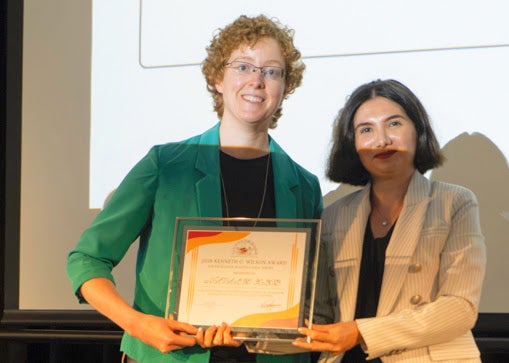
The National Quantum Laboratory (QLab) is thrilled to congratulate Dr. Natalie Klco (Duke University) on receiving the prestigious 2026 Kenneth G. Wilson Award for Excellence in Lattice Field Theory.
Sponsored by QLab, the award was announced during the 43rd International Symposium on Lattice Field Theory (Lattice 2026). QLab Fellow and UMD physics professor Zohreh Davoudi, who chaired the organizing committee of the conference, had the distinct honor of presenting the award.
Dr. Klco was recognized with the official award citation:
"For pioneering contributions to digital quantum simulations of lattice gauge theories."
A rising star in quantum physics
Dr. Klco’s work sits at the cutting-edge intersection of quantum information science and nuclear physics. She has made contributions to understanding the entanglement structures of quantum fields. By developing physical representations and algorithms to map complex lattice gauge theories onto qubits and qutrits, she is guiding the practical implementation of dynamical quantum simulations on near-term quantum hardware. Her research includes several important milestones in the field:
- Simulating the Schwinger model: Dr. Klco developed a quantum-classical algorithm to compute the dynamics of the Schwinger model, successfully demonstrating that exploiting rotational symmetries and parity can significantly reduce the required number of qubits on IBM's quantum computers by removing unphysical sectors from the Hilbert space.
- Non-Abelian gauge theories: Pushing beyond simpler models, she helped formulate and implement the time evolution of an SU(2) gauge field theory on digital quantum hardware. By utilizing an angular momentum basis, her work allowed for the exploration of gauge field interactions with qubit requirements that scale linearly with spatial volume.
- Entanglement structures in the vacuum: Dr. Klco has advanced the theoretical understanding of how quantum fields are entangled. She has mapped how many-body entanglement within the vacuum of non-interacting lattice scalar field theories can be locally transformed into tensor-product "negativity cores," shedding light on accessible and bound entanglement structures.
Her academic journey reflects a rapid and highly collaborative ascent through some of the world's top quantum research hubs:
- 2020: Earned her Ph.D. from the University of Washington, where she conducted research at the Institute for Nuclear Theory (INT).
- 2020–2022: Served as a Sherman Fairchild Postdoctoral Scholar at Caltech, working within the Institute for Quantum Information and Matter (IQIM).
- 2022: Joined the faculty at Duke University as an Assistant Professor, working closely with our good friends and collaborators at the Duke Quantum Center (DQC).
The legacy of Kenneth G. Wilson
The award’s namesake, Kenneth G. Wilson, profoundly reshaped modern physics and was awarded the 1982 Nobel Prize in Physics for his decisive contributions to the renormalization group method. Wilson also formulated lattice gauge theory in particle physics, which placed quantum chromodynamics (QCD) on a discrete space-time lattice, allowing physicists to finally analyze the strong interactions between quarks and gluons using supercomputers.
Wilson is also famous for a rather unconventional academic success story. Upon joining the Cornell physics department in 1963, he essentially ignored the notorious "publish or perish" culture. He published almost nothing for years, choosing instead to focus all his energy on deep, seemingly intractable problems in quantum field theory. As he later recounted in his Nobel biography, "My very strong desire to work in quantum field theory did not seem likely to lead to quick publications; but I had already found out that I seemed to be able to get jobs even if I didn't publish anything so I did not worry about publish or perish." This immense academic risk paid off, leading to breakthroughs that changed physics forever.
Beyond his direct work on phase transitions and lattice gauge theory, Wilson’s development of the numerical renormalization group (NRG) laid the conceptual groundwork for one of the most powerful computational tools in quantum physics today. It was Wilson’s Ph.D. student, Steven R. White, who went on to invent the density matrix renormalization group (DMRG) algorithm - the foundational breakthrough that launched the modern era of tensor networks.
A Shared Mission at QLab
The concepts championed by both Wilson and Klco are close to the heart of QLab’s core mission. The digital quantum simulation of lattice gauge theories, the advancement of tensor network algorithms, and the integration of nuclear physics with quantum information science represent major pillars of our research ecosystem.
By sponsoring the 2026 Kenneth G. Wilson Award, QLab reaffirms its commitment to supporting the next generation of visionary scientists who are translating the deepest laws of fundamental physics into the quantum technologies of tomorrow.
We extend our warmest congratulations to Dr. Natalie Klco on this well-deserved recognition!