
Securing fiber networks: Quantum-enhanced threat detection demonstrated at QLab
Network security is widely recognized as one of the most important applications of quantum technology, yet its large-scale deployment has long been bottlenecked by structural constraints. Traditional protocols often require tight coordination between quantum and classical processing layers, creating rigid interdependencies that conflict with the modular, layered architectures essential for modern scalable communication networks.
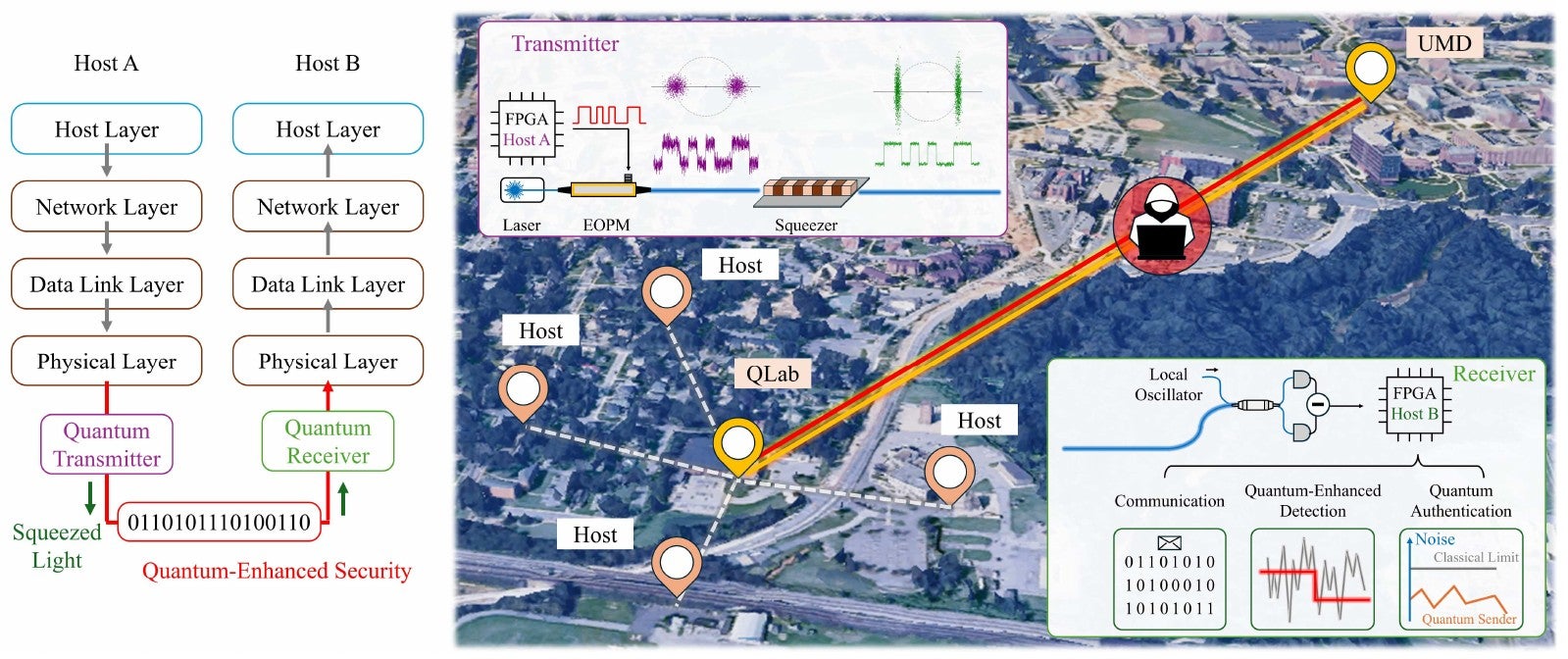
In a new collaborative paper titled "Quantum-enhanced physical-layer threat detection in metropolitan-scale fiber networks" (arXiv:2607.10799), a multi-institutional research team - including QLab Fellow Saikat Guha - has introduced a fundamentally different strategy and successfully field-tested it with hosts located at QLab communicating through a deployed fiber
network that connects to the UMD campus. By confining all quantum interventions strictly to the physical layer, the new framework achieves quantum-enhanced security while remaining transparently compatible with existing classical network abstractions.
Overcoming cross-layer bottlenecks
To date, much of the work in quantum-enhanced network security has relied heavily on quantum key distribution (QKD). While powerful, QKD fundamentally depends on a combination of quantum randomness at the physical layer and extensive classical post-processing at upper information-theoretic layers.
The new approach bypasses this friction by eliminating the need for complex cross-layer coordination. Instead of disrupting the traditional open systems interconnection (OSI) model, the researchers localized all modifications entirely within the physical layer.
Embedding quantum features via bright squeezed light
At the heart of the team's solution is the direct synthesis of quantum features and classical data into the exact same optical field.
- Bright squeezed light: The system coherently combines classical optical signals with squeezed vacuum, leveraging the sub-shot-noise variance native to squeezed light to detect anomalies beyond classical limits.
- CUSUM Analysis: Physical-layer signals are continuously analyzed using a cumulative sum (CUSUM) statistical quality-control method, allowing the network to flag potential threats and unauthorized optical tapping with heightened sensitivity.
Seamless interoperability: Because the quantum enhancements live entirely within the physical optical stream, upper network layers remain completely unmodified and scalable.
Real-world field validation
To prove the practicality of their framework, the research team pushed the technology into the real world. They successfully validated the system through a live field deployment connecting hosts at the National Quantum Laboratory (QLab) Campus-Drive site with the Atlantic Building on the main UMD campus.
- Metropolitan-Scale Fiber Loop: The deployed fiber connecting QLab and the UMD campus formed a loop exceeding 5 kilometers in length. The link presented a total attenuation of approximately 9 dB, primarily caused by fiber-to-fiber connectors.
- Environmental Mitigation & Routing: To counteract environmental fluctuations across the deployed fiber, the system utilized differential Manchester encoding (DME), which encodes information directly into signal transitions. An optical switch located in QLab allowed for active path reconfiguration.
- Live Threat Detection: During the field trial, the researchers introduced a simulated 10% optical tapping event, which the system successfully detected using the CUSUM statistical analysis without disrupting the standard TCP data throughput (characterized using iPerf between the host servers).
- Long-Term Stability: The deployment demonstrated remarkable stability, executing continuous squeezing evaluations and network operation over a 20-hour period entirely without human intervention.
Looking ahead
This work establishes a practical, scalable blueprint for integrating quantum-enhanced security directly into existing telecommunications infrastructure. By preserving modular network design while harnessing security benefits of quantum optics, the work suggests a realistic way for a more secure and resilient fiber-optic backbone.
In a collaboration between the University of Texas at Austin, RTX BBN Technologies, University of California at San Diego, and the National Quantum Laboratory (QLab), the research was conducted by Yung-Cheng Kao, Siddharth Pal, Alex Forencich, Dylan Cirimelli-Low, Chaohan Cui, Jack Postlewaite, Pao-Kang Chen, Nicola Alic, Saikat Guha, Prithwish Basu, and Linran Fan.
Read the full preprint on arXiv: arXiv:2607.10799