
Realization of polarization-to-time-bin conversion: A vital tool for the quantum internet
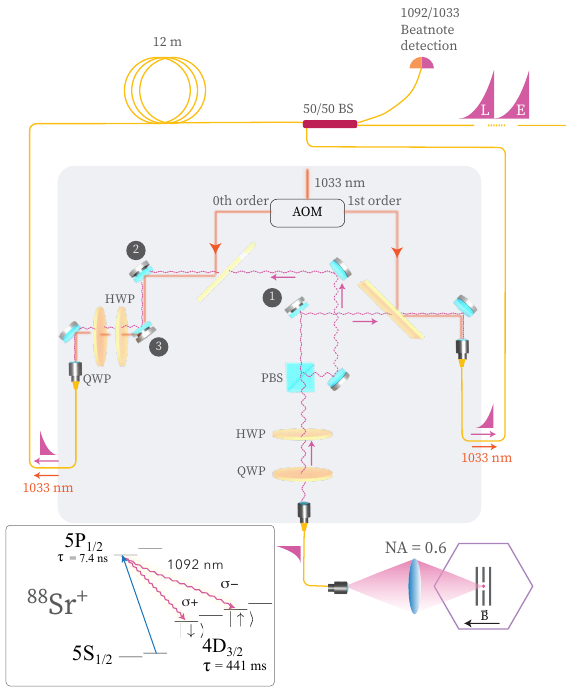
As researchers around the world race to build the foundation for quantum networks, transmitting quantum information reliably over long distances remains a formidable challenge. A critical milestone in this pursuit was recently achieved by a team lead by QLab director Norbert Linke. In the new paper, "Robust Ion-Photon Entanglement via Polarization-to-Time-Bin Conversion" (arXiv:2607.07805), researchers Ana Luiza Ferrari, Denton Wu, Mika A. Zalewski, and Norbert Linke demonstrate a novel technique to preserve delicate quantum entanglement against the noisy environments of optical fiber networks.
The fragility of polarization in optical fibers
The idea is to used trapped ions as stationary quantum memories and quantum processing units, while single photons act as "flying qubits" that carry quantum information between network nodes. The ion qubits establish entanglement with the emitted photons through polarization - the spatial orientation of the photon's oscillating electromagnetic field.
However, polarization-encoded qubits are highly susceptible to environmental decoherence when transmitted through standard optical fibers. Silica fibers naturally exhibit birefringence, meaning light travels at slightly different speeds depending on its polarization. As the fiber experiences temperature fluctuations and mechanical vibrations from the environment, the physical stress on the glass changes constantly. This causes the birefringence to fluctuate unpredictably, scrambling the photon's polarization state. In a noisy environment, just one minute of this instability can severely degrade the fidelity of the entanglement, destroying the quantum information.
Generating the initial entanglement
Before they could protect the entanglement, the team first had to generate a high-fidelity entangled state between a trapped Strontium ion ($^{88}\text{Sr}^+$) and a single photon.
The sequence begins by Doppler cooling the ion, followed by optically pumping it to initialize it in a specific spin state ($\vert{}5S_{1/2}, +1/2\rangle$). A precisely timed 20-nanosecond laser pulse at 422 nm then excites the ion to a higher energy level ($\vert{}5P_{1/2}, -1/2\rangle$). As the ion spontaneously decays, there is a probability that it will emit a single photon at 1092 nm. Due to the fundamental conservation of angular momentum, the polarization of this emitted photon (horizontal or vertical) is perfectly tied to the final spin state of the ion. This process creates a pristine, polarization-entangled ion-photon pair.
The solution: Converting the qubit in flight
To bypass the vulnerability of polarization without sacrificing the high-quality atomic entanglement, the researchers developed a hybrid conversion approach: They passed the newly emitted 1092 nm photon through a polarization-discriminating asymmetric Mach–Zehnder interferometer. This specialized optical device uses a polarizing beam splitter to separate the photon's path based on its state. If the photon is horizontally polarized, it takes a short path; if vertically polarized, it travels through a 12-meter fiber delay line, taking 60 nanoseconds longer.
When the paths merge back together, the quantum information is no longer stored in the spatial orientation of the electric field, but rather in the exact arrival time of the photon (an "early" or "late" time-bin). This translates the state directly into a time-bin qubit, which is highly robust against the birefringence of fiber-optic cables.
Decoding the qubit at the receiving node
This conversion also simplifies how the receiving node of the quantum network handles the incoming quantum information.
- Receiving polarization qubits: If the photon state had remained polarization-encoded, the receiving node would decode the information using a sequence of waveplates and a polarizing beam splitter. However, because of the random polarization drift in the fiber, the incoming photon's axes would constantly arrive misaligned. The network would be forced to periodically halt quantum data transmission to send classical calibration pulses and physically readjust the receiver's waveplates.
- Receiving time-bin qubits: By converting to a time-bin qubit, the receiving node simply uses an identical, stable asymmetric Mach-Zehnder interferometer to overlap the "early" and "late" time bins. Because the 60-nanosecond temporal spacing between the pulses is physically immune to thermal drift and fiber vibrations, they interfere perfectly at the receiver. This allows the receiving node to measure the quantum information continuously and reliably without the need for active environmental stabilization.
A resilient quantum network
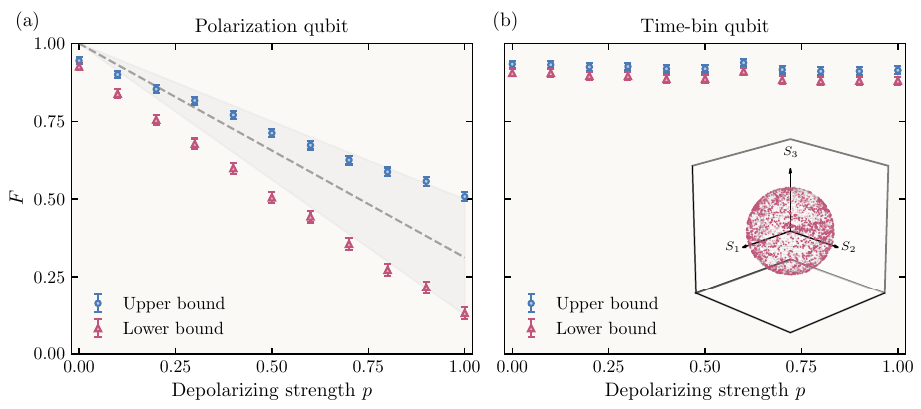
These experiments represent the first entanglement-preserving polarization-to-time-bin conversion of a photon qubit entangled with an ion qubit. The team measured an impressive fidelity $0.906\pm 0.011\leq \mathcal{F}\leq 0.934\pm0.011$ for the time-bin encoded ion-photon state. They also determined the conversion error to be less than 0.028, implying that the majority of the fidelity loss is due to other sources like preparation errors, photon emission and collection imperfections, deviations in waveplate alignment, ion readout error, and ion spin decoherence.
To put their system to the ultimate test, they deliberately injected severe depolarizing noise into the fiber link. Remarkably, the fidelity of the converted time-bin state remained virtually unaffected, even at full depolarization strength. This is at sharp contrast to the decay of the polarization-encoded state. Furthermore, because the 1092 nm wavelength naturally experiences very low attenuation in silica fibers (0.74 dB/km), the conversion was achieved with incredibly low optical loss.
By enabling the seamless, robust transmission of qubits between different platforms, this technology provides a vital building block for scalable, heterogeneous quantum network architectures.