
Study on entanglement scaling across a quantum phase transition published in Nature Communications
A collaboration between QLab's Thomas Barthel and scientists at the Duke Quantum Center has demonstrated a powerful new approach for studying strongly correlated quantum matter on quantum computers. The team used a trapped-ion processor to access a continuous quantum phase transition in an effectively infinite system and to measure how quantum entanglement changes across the transition.
The study, “Probing entanglement scaling across a quantum phase transition on a quantum computer,” was published in Nature Communications 17, 9110 (2026). The research team comprised Qiang Miao, Tianyi Wang, Kenneth R. Brown, Thomas Barthel, and Marko Cetina.
Overcoming the limits of small quantum computers
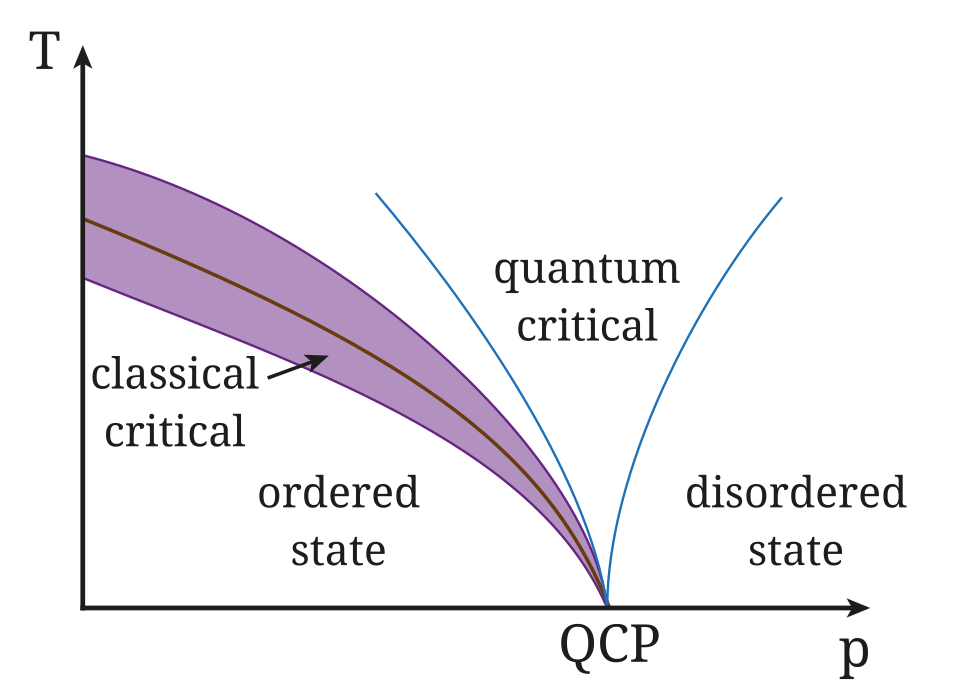
Quantum phase transitions occur at zero temperature when a change in a physical parameter causes the ground state of a quantum many-body system to drastically reorganize in a non-analytic way, e.g., changing from an non-magnetic to a magnetic state. Near a continuous transition, fluctuations and correlations extend across all length scales, while the ground state develops a complex pattern of quantum entanglement. At the critical point, the system becomes self-similar, also implying that long-range features are largely independent of microscopic details. This leads to universality - the fact that each fundamentaly type of phase transitions can be observed in very different physical systems. These properties make critical systems very important, but also exceptionally difficult to simulate.
Quantum processors are promising platforms for investigating such systems. Yet current devices contain relatively few qubits, whereas phase transitions are rigorously defined only for infinitely large systems. Directly measuring entanglement between a subsystem and the rest of the system presents another obstacle: reconstructing the quantum state of a large subsystem generally requires a number of measurements that grows exponentially with its size.
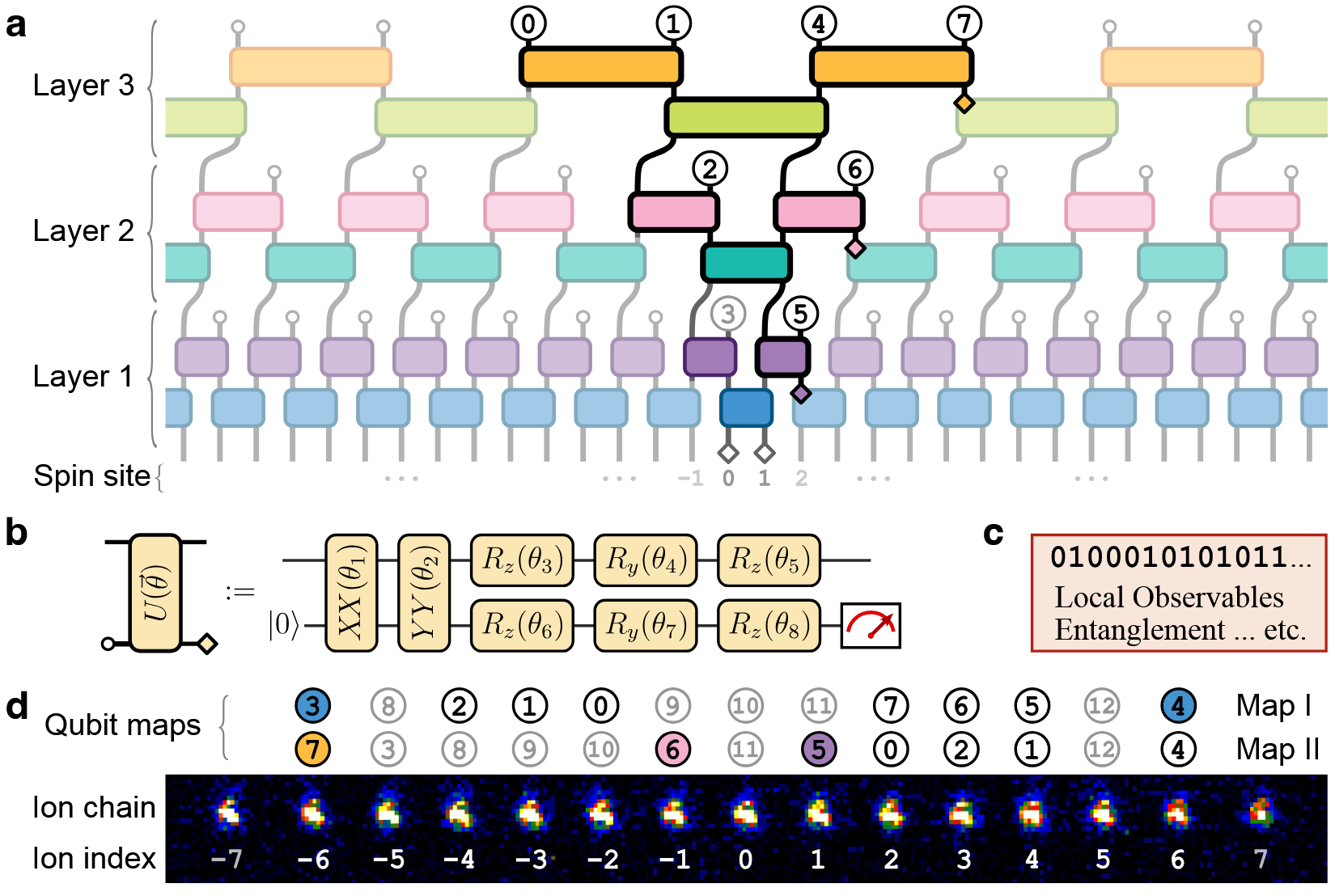
To address these challenges, the researchers employed the multiscale entanglement renormalization ansatz (MERA). MERA represents quantum many-body states as a hierarchical tensor network in which successive layers encode correlations at increasingly large length scales (lower and lower energy scales). Its structure mirrors the renormalization-group framework used in condensed-matter physics to explain universal behavior near phase transitions.
Because only a small portion of the MERA network - the “causal cone” of a target observable - affects a given measurement, the corresponding quantum circuits can remain compact even when the represented physical system is very large. In the experiment, the team implemented MERA circuits for a (formally) infinite-size system on a fully connected processor consisting of 15 ytterbium ions.
An infinite system encoded with a few qubits
The researchers applied their method to the one-dimensional transverse-field Ising model, a foundational model of quantum magnetism with a well-understood transition between ferromagnetic and paramagnetic phases.
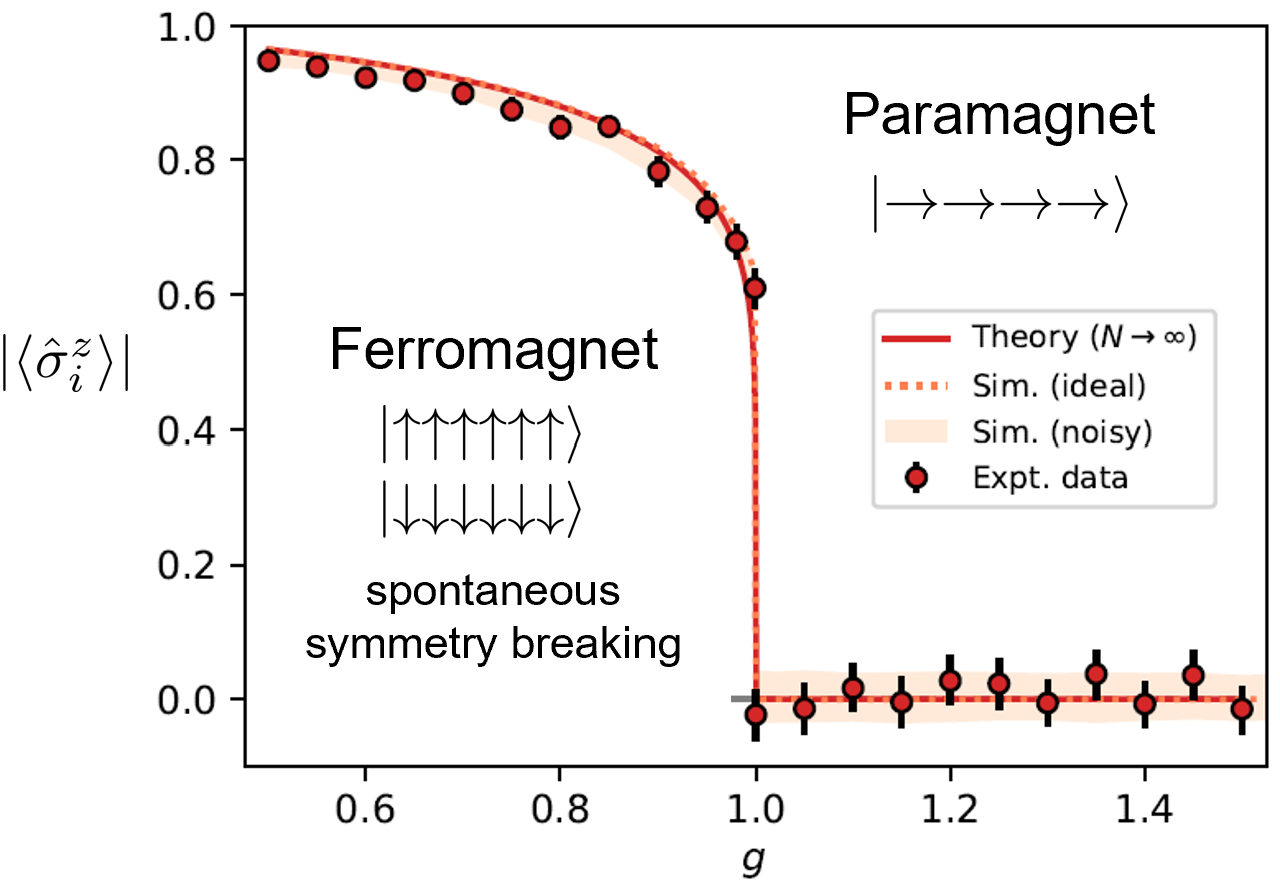
The MERA circuits represented the system directly in the thermodynamic limit - that is, as an infinite chain - while capturing correlations over effective distances of up to 96 lattice sites. Measurements of the magnetization clearly resolved the onset of spontaneous symmetry breaking at the phase transition. From the experimental data, the researchers also extracted a critical exponent of 0.117(4), close to the exact Ising-model value of 1/8.
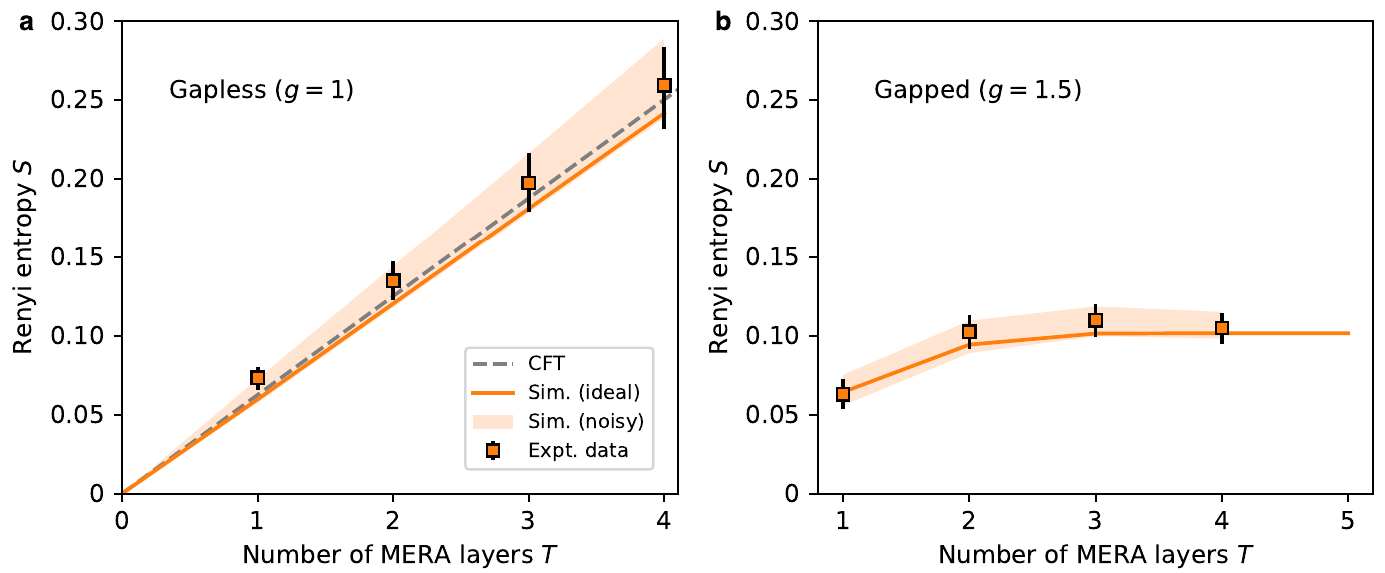
Beyond identifying the transition, the team investigated how the structure of entanglement changes near the critical point. Away from criticality, correlations remain short-ranged, and the entanglement entropy of a subsystem approaches a constant as its size grows. This behavior is known as an area law. At the critical point, correlations extend over all length scales, and conformal field theory predicts that the entanglement entropy instead grows logarithmically with subsystem size.
Distinguishing these scaling laws experimentally has been difficult because small systems are strongly affected by finite-size effects and direct tomography becomes prohibitively expensive for large subsystems.
Holographic measurements reveal entanglement scaling
The researchers overcame this measurement bottleneck with a new protocol they call holographic subsystem tomography. Rather than reconstructing every qubit in a large physical subsystem, the method uses the causal structure of MERA to compress the relevant information into a small number of renormalized qubits located along the subsystem boundary.
The required number of measured qubits and the circuit depth consequently grow only logarithmically with the effective system size. This allowed the team to reconstruct subsystem density matrices, entanglement entropies, and entanglement spectra with high fidelity.
At the critical point, the measured Rényi entanglement entropy increased linearly with the number of MERA layers - corresponding to the logarithmic growth with subsystem size predicted by conformal field theory. Away from the transition, the entropy rapidly saturated, as expected from the area law. According to the researchers, this is the first demonstration of log-law scaling of subsystem entanglement entropy at criticality on a digital quantum computer.
The measurements also revealed characteristic changes in the entanglement spectrum, including the closing of the Schmidt gap as the effective subsystem size increased at criticality.
A route toward challenging quantum-material simulations
The experiment demonstrates how incorporating physical structure into quantum algorithms can allow small, noisy quantum processors to describe phenomena associated with much larger systems. MERA circuits have logarithmic depth, are comparatively resilient to noise, and avoid the barren-plateau problem that can make variational quantum algorithms difficult to optimize.
Although the Ising-model implementation used here can still be simulated classically, the approach is designed to scale to more challenging problems. Larger MERA circuits could help investigate higher-dimensional frustrated magnets, fermionic systems, nonequilibrium dynamics, and other strongly correlated systems whose simulation becomes prohibitively expensive on classical computers.
The work was supported by the NSF Quantum Leap Challenge Institute for Robust Quantum Simulation and the U.S. Department of Energy’s Quantum Systems Accelerator.
Reference: Q. Miao, T. Wang, K. R. Brown, T. Barthel, and M. Cetina, “Probing entanglement scaling across a quantum phase transition on a quantum computer,” Nature Communications 17, 9110 (2026); arXiv:2412.18602.