QLab gives Terp families a glimpse into the world of quantum computing at UMD
During the University of Maryland's recent Family Weekend, QLab welcomed Terp students and their families for a behind-the-scenes introduction to quantum computing research at UMD.
The visit began with an introduction by QLab Director Norbert Linke, who outlined how researchers use the counterintuitive laws of quantum physics to process information in new ways. He also highlighted UMD’s growing quantum ecosystem and QLab’s role in connecting researchers, students, educators and other users with quantum computing resources and expertise.
Seeing individual atoms in action
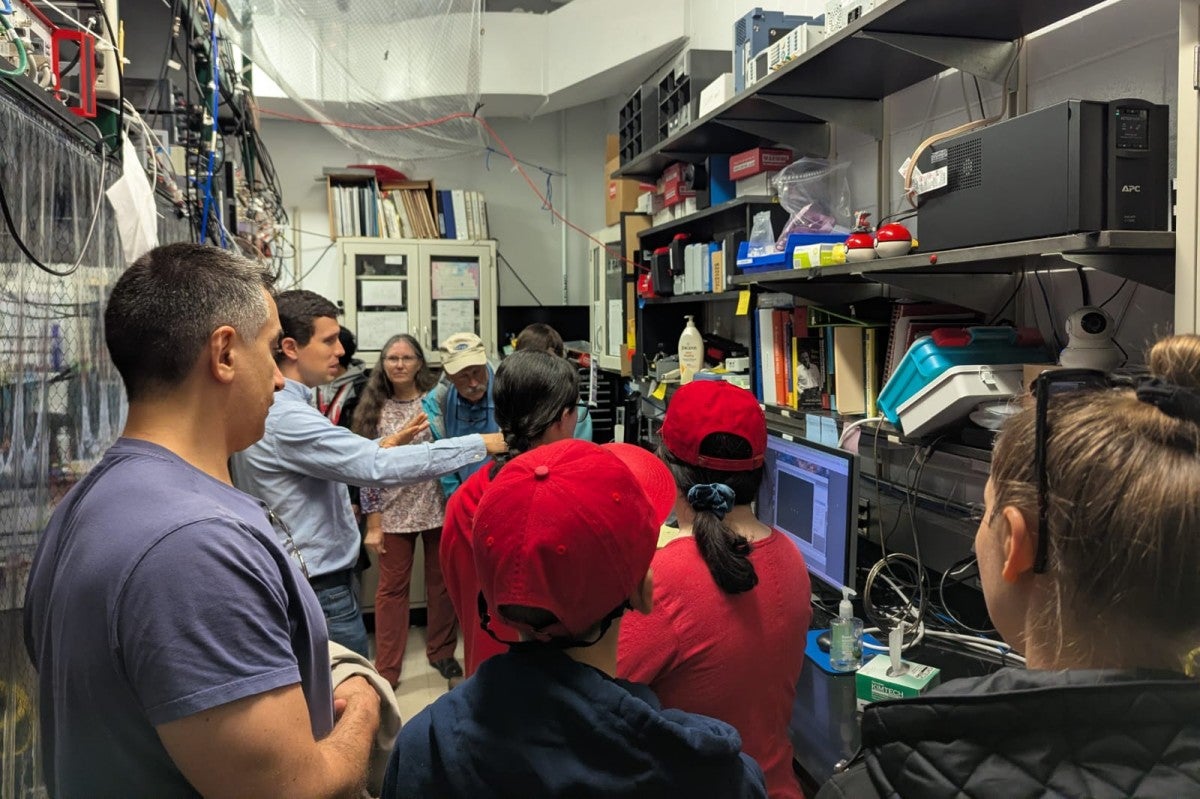
The group toured the ion-trap quantum computing laboratory, where visitors saw a live demonstration of individual atomic ions being confined inside a vacuum chamber.
In a trapped-ion quantum computer, electrically charged atoms are suspended using electromagnetic fields and controlled with precisely tuned laser pulses. The ions’ internal quantum states serve as qubits - the basic units of quantum information. Because individual ions can be prepared, manipulated and measured with exceptional precision, trapped-ion systems provide a powerful platform for both quantum computation and fundamental research.
The experiment shown during the tour is used to investigate advanced methods for controlling quantum systems. Improving such control is essential for executing quantum algorithms accurately, understanding and reducing errors, and developing increasingly capable quantum computers.
For many visitors, seeing the tiny points of light produced by individual ions offered a striking connection between the abstract concepts of quantum physics and the physical systems used in today’s laboratories.
Testing quantum computers through games
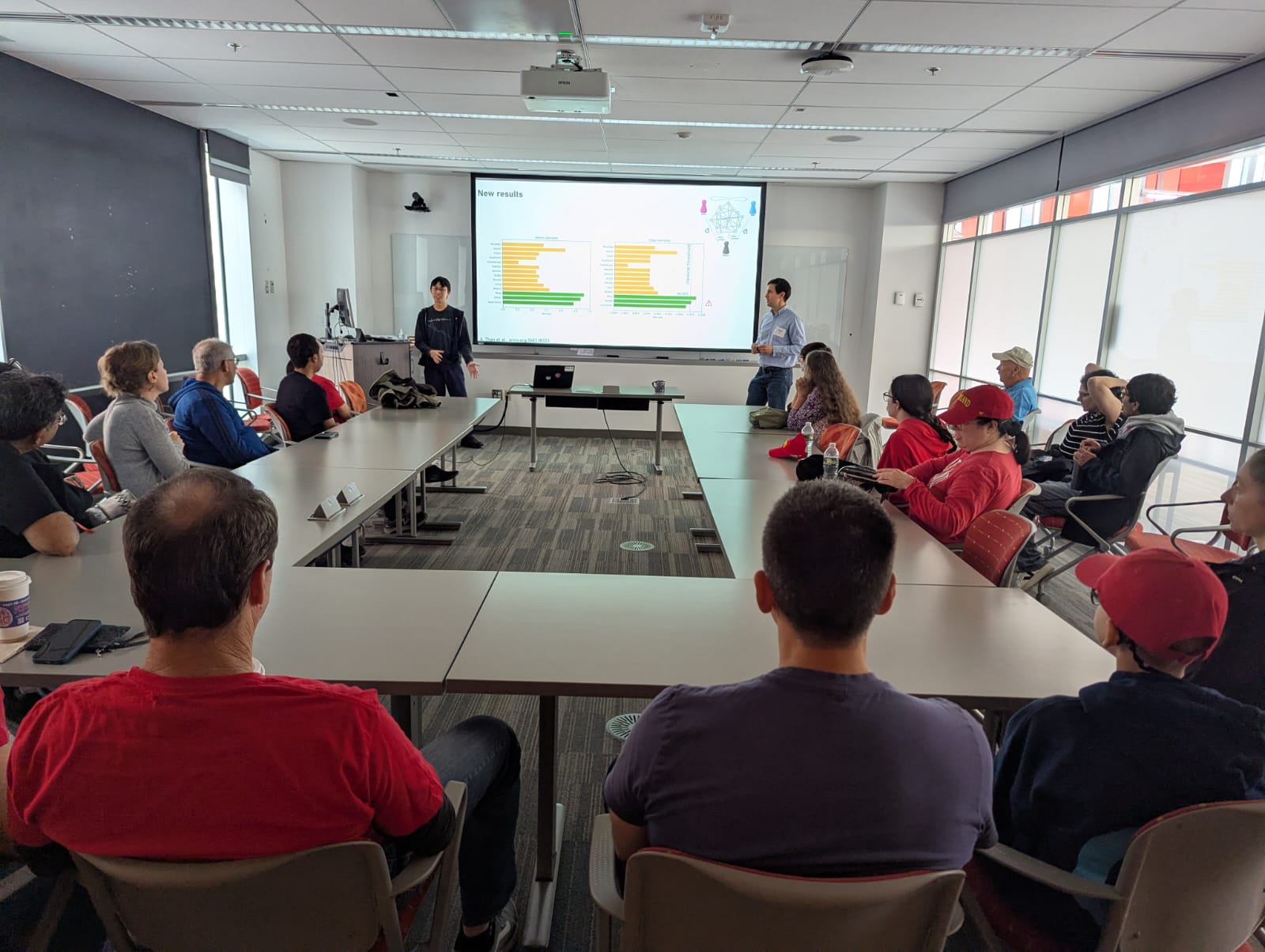
The families also heard from UMD graduate student Anton Than, who explained how games can be used to explore and measure the capabilities of quantum computers.
Than introduced graph-coloring games, which are based on the mathematical challenge of assigning colors to the vertices of a graph while ensuring that connected vertices receive different colors. In certain nonlocal versions of these games, separated players must coordinate their answers without communicating during play.
Classical physics places strict limits on how often the players can win. Quantum computers, however, can use entanglement to coordinate their responses in ways that exceed those classical limits. Running the same game on different quantum processors therefore provides researchers with a way to test and compare entire quantum systems, including the quality of their qubits, operations and measurements.
QLab researchers recently used nonlocal graph-coloring games across several trapped-ion processors, demonstrating how these games can serve as cross-platform benchmarks while also probing one of the most distinctive features of quantum mechanics.
Connecting Terp families with UMD research
Held September 25-27, Family Weekend 2026 brought thousands of parents, siblings and other relatives to College Park for more than 100 activities across campus. QLab’s tour was among the academic programs that invited families to experience the research and educational opportunities available at UMD.
By combining a laboratory visit with an accessible look at quantum algorithms and benchmarking, the event gave Terp families a glimpse of how quantum computing brings together physics, mathematics, engineering and computer science - and how UMD researchers are helping to advance the field.
Read more about the weekend in Maryland Today’s Family Weekend recap.