
Quantum networking shares a fiber with high-speed telecommunications
A collaboration lead by QLab Director Norbert Linke and Duke University Professor Tingjun Chen has demonstrated that a trapped-ion quantum link can operate alongside conventional telecommunications on the same optical fiber. The team distributed entanglement between an ion and a photon through a deployed 2.8-kilometer fiber loop while Ethernet and 5G signals shared the connection. The work addresses a practical question for future quantum networks: How can they use the infrastructure already carrying our data?
Optical fibers connect buildings and cities, but making them useful for quantum communication requires more than getting light from one end to the other. A quantum receiver must distinguish individual photons from unwanted light and preserve the information encoded in their quantum states. Understanding the experiment means following both problems, from the trapped atom to the far end of the fiber.
An atom that stays and a photon that travels
A quantum network needs ways to hold information at its nodes and move it between them. Trapped ions are electrically charged atoms confined by electromagnetic fields in a vacuum chamber. Their internal states can encode qubits, and lasers allow researchers to prepare, manipulate, and measure them. Photons serve a complementary role: They travel readily through optical fiber and can carry quantum information away from a stationary node.
The connection between these roles is entanglement. Two entangled systems have quantum correlations that cannot be reproduced by simply assigning each system an independent state. Establishing entanglement between a stationary qubit and a traveling photon is therefore a useful step toward linking quantum memories and processors. Such links could eventually support distributed quantum computation and measurements involving geographically separated sensors.
In the strontium-ion platform, laser excitation is followed by photon emission. Different allowed emission pathways connect the final internal state of the ion to different photon polarizations. Preserving a coherent superposition of these pathways creates an entangled ion-photon state. Polarization describes how the electric field of light oscillates; two orthogonal polarizations provide the two basis states of the photon qubit.
Detecting one photon amid bright telecommunications signals
Sharing fiber is routine in classical communications. Wavelength-division multiplexing combines light at different wavelengths into one fiber and separates the channels again at the destination. The wavelengths act like distinct colors, even when all are in the infrared and invisible to our eyes. This lets several services use the same glass strand.
Quantum signals impose a much stricter requirement on that separation. Classical optical channels contain many photons, whereas a quantum receiver may be waiting for a single detection event. Even a tiny fraction of unwanted light can create false detections and obscure the correlations. Dedicated fibers without telecommunications traffic, often called dark fibers, avoid this source of interference but restrict the infrastructure available for quantum links.
There is also a subtler source of unwanted photons. Through Raman scattering, light exchanges energy with vibrations in the glass and emerges at different wavelengths. Separating the original carrier wavelengths is therefore insufficient if scattered photons reach the quantum channel. Choosing wavelengths requires considering the noise spectrum as well as how strongly the fiber attenuates the desired light.
The team used 1092-nanometer ion photons, separated from telecom signals near 1550 nanometers, and combined wavelength, interference, and spatial filtering. Telecom-induced detector background fell to the detectors’ dark-count level. This avoided frequency conversion, although 1092-nanometer light experiences greater fiber loss than optimal telecom wavelengths.
This illustrates an engineering tradeoff: the wavelength with the smallest transmission loss need not give the best overall quantum link. A useful design must also account for unwanted detections and the complexity of converting photons between wavelengths. At kilometer scales, keeping the detector background low can be especially valuable.
Keeping the polarization aligned as the fiber changes
A photon can reach its destination and still be measured incorrectly if the fiber changes its polarization. Optical fibers exhibit birefringence: different polarization components acquire different phases as they propagate. Temperature changes and mechanical stress alter that transformation over time. A receiver calibrated earlier may consequently analyze the arriving qubit along the wrong polarization axes.
A stable, reversible polarization rotation does not by itself erase entanglement. If researchers know the rotation, they can compensate for it. The difficulty is tracking a transformation that changes during operation. Averaging measurements over unknown rotations can wash out the correlations that reveal entanglement.
Here, 1530-nanometer sensing beams monitored drift. Periodic or drift-triggered corrections briefly paused entanglement generation and used 1092-nanometer reference beams with a piezoelectric fiber squeezer. Correction occupied only 0.7% of the experimental run.
A fiber squeezer applies controlled mechanical stress to change the fiber’s optical response. Feedback adjusts that response until reference polarizations return to their targets. Using bright reference beams makes these adjustments measurable without trying to infer every change from rare quantum detections.
Coordinating the link and checking its performance
Quantum networking also needs ordinary communication. A transmitter must learn whether a photon was detected and whether the receiver is ready. Otherwise, a node cannot reliably decide when to retain a quantum state, make a measurement, or try again. Entanglement supplies quantum correlations, but it does not replace these classical messages or allow information to travel faster than light.
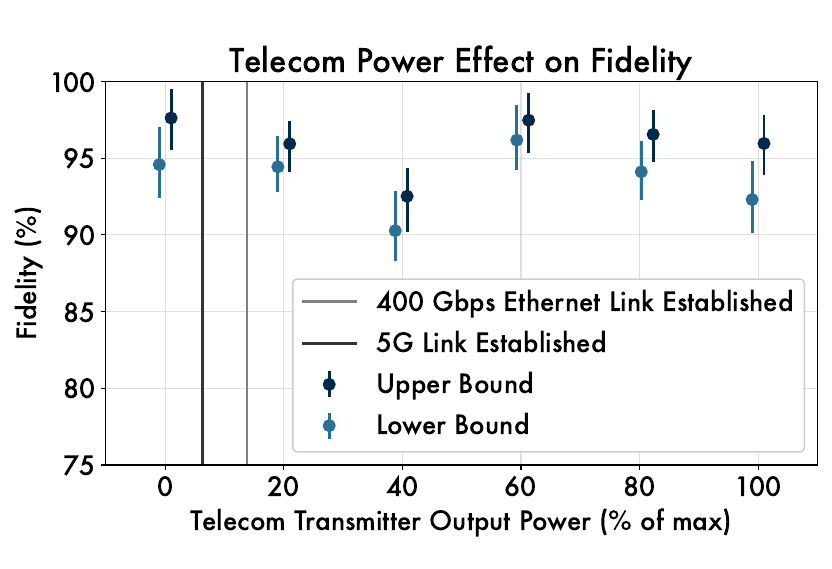
All inter-node control signals shared the fiber. Over 13 hours and 46 minutes, the experiment recorded 32,500 events, averaging 39.3 per minute. Average fidelity bounds were 92.4% and 96.1%. Concurrent 400-Gbps Ethernet and 5G radio-over-fiber remained functional.
Fidelity measures the agreement with the intended quantum state, with a value of one representing perfect agreement. It is different from transmission efficiency: Many photons can be lost even when the successfully detected events retain high-quality quantum correlations. Likewise, an entanglement event rate is not a conventional data rate. These quantities answer different questions about whether a link is accurate, efficient, and useful.
The experiment established ion-photon entanglement rather than entanglement between two remote ions. That distinction matters when considering the next step. A network connecting quantum processors must build on such interfaces to establish and use entanglement between stationary nodes, while coping with probabilistic photon generation, transmission loss, and finite memory lifetimes.
Toward quantum links on existing networks
Reusing installed fiber could reduce the need for dedicated quantum connections. It also puts quantum hardware into the environments where networks must ultimately operate, where optical paths fluctuate and infrastructure is shared. Field demonstrations help identify which laboratory techniques remain effective under those conditions.
The remaining tasks are substantial: Deliver useful entanglement more frequently, preserve it long enough to coordinate operations, and extend reliable operation across multiple nodes. This demonstration addresses the infrastructure question by showing that a quantum memory can participate in an optical link while the same fiber continues to carry conventional services.
Read the full preprint on arXiv:
Denton Wu, Mingzhe Han, Zehao Wang, Ana Luiza Ferrari, Mika A. Zalewski, Yuanheng Xie, Tingjun Chen, and Norbert M. Linke, “Trapped Ion Quantum Networking and Telecommunications Coexisting on One Fiber,” arXiv:2609.06387 (2026).