
Strong-to-weak symmetry breaking transition demonstrated on superconducting quantum computers
Noise is usually expected to destroy order in a quantum system. But new experiments carried out with quantum-computer access provided by QLab shows how spatially correlated noise can instead drive a mixed quantum state toward an unconventional ordered phase - one that remains invisible to ordinary correlation measurements.
Researchers used IBM superconducting quantum processors to reconstruct finite-size critical signatures of a transition known as strong-to-weak spontaneous symmetry breaking (SW-SSB). The transition is unusual because it does not produce conventional magnetic order. Instead, it appears only in observables that depend nonlinearly on the system’s density matrix.
The study, “Strong-to-weak spontaneous symmetry breaking transitions on a quantum processor” (arXiv:2610.26229) was conducted by Zhi-Yuan Wei, Christopher Fechisin, Yu-Xin Wang, Jeet Shah, Tsung-Cheng Lu, Cheng-Ju Lin and Alexey V. Gorshkov. The team includes researchers from the Joint Quantum Institute and the Joint Center for Quantum Information and Computer Science at the University of Maryland and NIST, together with collaborators at the University of Oklahoma, BlueQubit and the University of Miami.
The companion paper “Mixed-state phases induced by power-law quantum channels” (arXiv:2610.00480) explains why the transition occurs and connects it to a familiar model from classical statistical physics.
A symmetry that can weaken without disappearing
Symmetry breaking is one of the principal phenomena used to distinguish phases of matter. A magnet, for example, can obey rotational symmetry at high temperature but select a particular magnetization direction below a critical temperature.
Mixed quantum states admit a more subtle distinction between two kinds of symmetry. For the global spin-flip operator $U_X=\prod_i X_i$, a density matrix $\rho$ has a strong symmetry with respect to the $z$ axis when $U_X\rho=\rho$. The less restrictive weak symmetry only requires $U_X\rho U_X^\dagger=\rho$.
For pure states, this distinction largely disappears. For mixed states, however, a phase can spontaneously break the strong symmetry while preserving the weak one. In a doubled description of the density matrix, this corresponds to breaking the independent symmetry $\mathbb{Z}_2^{\text{bra}}\times\mathbb{Z}_2^{\text{ket}}$ down to the diagonal $\mathbb{Z}_2$ symmetry that acts on both copies together.
This SW-SSB order is not revealed by an ordinary correlator such as $C_I(i,j)=\operatorname{Tr}(\rho Z_iZ_j)$. Instead, it appears in nonlinear quantities including the Rényi-2 correlator $C_{II}(i,j)=\operatorname{Tr}(\rho Z_iZ_j\rho Z_iZ_j)/\operatorname{Tr}(\rho^2)$. SW-SSB is indicated when $C_{II}(i,j)$ remains nonzero at large spatial separations $|i-j|$ while $C_I(i,j)$ decays.
A tunable model of mixed-state quantum matter
The researchers began with a certain family of matrix-product states $\lvert\psi_g\rangle$ controlled by a parameter $g$. Varying $g$ connects three familiar limits: a one-dimensional cluster state at $g=-1$, a Greenberger-Horne-Zeilinger (GHZ) state at $g=0$, and the product state $\lvert+\rangle^{\otimes N}$ at $g=1$. States with $g<0$ belong to a symmetry-protected topological phase, while those with $g>0$ are topologically trivial. The GHZ state at $g=0$ already exhibits conventional long-range order.
The team then considered correlated dephasing in which pairs of qubits experience a $Z_iZ_j$ error. For each pair of sites $i$ and $j$, the channel acts as $\mathcal{E}_{ij}(\rho)=(1-p_{ij})\rho+p_{ij}Z_i Z_j\rho Z_i Z_j$, where $p_{ij}=p/[K_N(\alpha)|i-j|^\alpha]$. Here, $p$ controls the overall strength of the dephasing, while $\alpha$ determines how quickly its correlations decrease with distance. The factor $K_N(\alpha)$ normalizes the interaction when it becomes sufficiently long-ranged.
Every $Z_iZ_j$ error commutes with the global spin flip $U_X$: The two minus signs generated by the two $Z$ operators cancel. The channel therefore preserves the model’s global strong symmetry, even though it can drive the system into a phase that spontaneously breaks that symmetry in the thermodynamic limit.
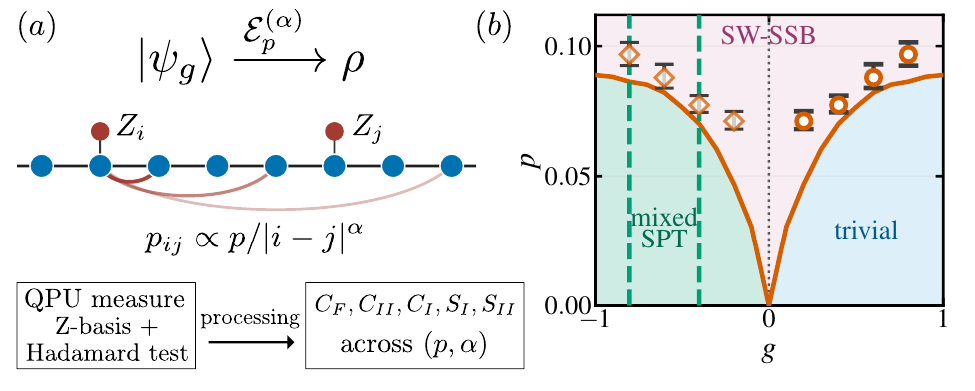
(b) Phase diagram for the spontaneous strong-to-weak symmetry breaking transition at α = 1.4.
Why correlated noise produces the transition
The counterintuitive transition can be understood by mapping the nonlinear Rényi-2 correlator to a classical statistical-mechanics problem. Because $C_{II}$ contains two copies of $\rho$, the calculation introduces two sets of classical spins, $s_i^L$ and $s_i^R$, associated with the bra and ket copies of the density matrix. The relevant composite variable is $q_i=s_i^L s_i^R$.
In this doubled description, the correlated dephasing channel generates a ferromagnetic interaction between the composite spins. At long distances, its coupling behaves approximately as $J_{ij}\sim p/|i-j|^\alpha$. At the fixed points $|g|=1$, the resulting partition function $\mathcal{Z}$ takes the form of a long-range Ising model, $\mathcal{Z}\propto\sum_{\{q_i\}}e^{2\sum_{i<j}J_{ij}q_i q_j}$, and the quantum Rényi-2 correlator becomes the classical spin correlator $C_{II}(i,j)=\langle q_i q_j\rangle$.
This mapping explains the transition. Increasing $p$ strengthens the effective ferromagnetic interaction between the composite spins. For sufficiently long-range interactions ($\alpha<2$), a one-dimensional Ising model can undergo a finite-coupling ordering transition. Above a critical value $p_c(g,\alpha)$, the $q_i$ variables therefore develop long-range order, and $C_{II}(i,j)$ remains finite at large distances.
The ordinary correlator $C_I$, by contrast, maps to a short-range one-dimensional problem and remains short-ranged for finite $g\ne0$. The transition consequently produces nonlinear order without conventional two-point order: The strong symmetry is broken while its weak, diagonal form remains intact. This also explains why adding noise can apparently create order. The dephasing is not generating ordinary magnetization. It is creating correlations between the bra and ket copies of the mixed state, which are detected only by nonlinear observables.
Away from $|g|=1$, the initial matrix-product state contributes additional short-range interactions proportional to $\ln|g|$. These interactions reinforce ordering of the composite variables. As $|g|$ approaches zero, the initial state approaches the GHZ state and progressively less dephasing is needed; accordingly, the theory predicts $p_c\to 0$. At $g=0$, the state is already symmetry-broken.
The long range of the channel is essential. For $\alpha>2$, its effective interactions are too short-ranged to support an extended finite-$p$ SW-SSB phase in one dimension, apart from a special isolated point at $p=1/2$.
Five observables from two measurement settings
Nonlinear functions of a density matrix are generally difficult to measure. They may require multiple copies of a state, randomized measurements or full quantum-state tomography.
The researchers developed a more efficient approach tailored to the known dephasing channel. Rather than physically applying a different noisy channel for every choice of $p$ and $\alpha$, they prepared the pure matrix-product states $\lvert\psi_g\rangle$, recorded quantum measurement outcomes and incorporated the channel’s exactly known probabilities during classical post-processing.
A single computational-basis measurement setting supplied the data needed to reconstruct the linear correlator $C_I$, the Rényi-2 correlator $C_{II}$ and a nonlinear fidelity correlator $C_F=\left\|\sqrt{\rho}\,Z_i Z_j\sqrt{\rho}\right\|_1$. One additional Hadamard-test setting provided access to the linear and Rényi-2 string observables $S_I$ and $S_{II}$, which were used to probe topological order.
The separation between quantum measurements and channel-dependent processing allowed the same experimental data to be reused for many values of $(p,\alpha)$. In total, the protocol reconstructed five observables using only two measurement settings.
Critical signatures on IBM quantum processors
Through QLab, the researchers accessed two 156-qubit IBM Heron R3 processors. Computational-basis measurements were performed on ibm_pittsburgh, while the Hadamard-test measurements were conducted on ibm_boston. To make efficient use of the processors, identical circuits were placed on multiple disjoint groups of physical qubits and measured in parallel.
For representative parameters, the scaled fidelity and Rényi-2 correlators exhibited crossings as the system size $N$ increased. After finite-size rescaling, data collapsed onto approximately common curves near the estimated critical points. At the same time, the ordinary linear correlator decreased approximately exponentially with $N$. The researchers then reused the measurement data to estimate transition points across several values of $g$ and $\alpha$. The resulting trends followed the phase structure predicted by the long-range Ising mapping.
The fidelity and Rényi-2 diagnostics did not always yield identical transition points. This is expected: They are distinct nonlinear probes and can be governed by different Rényi limits and finite-size effects. Together, however, their crossings and scaling collapses provide complementary finite-size evidence for the transition.
Connecting topological order and quantum information
For $g<0$, the low-noise side of the phase diagram is predicted to host a mixed-state symmetry-protected topological phase. Its conventional string order $S_I$ vanishes under dephasing, but its nonlinear Rényi-2 string order $S_{II}$ can remain finite.
The hardware measurements displayed this contrast. Linear string correlations were rapidly suppressed, whereas their Rényi-2 counterparts remained considerably more robust below the independently estimated SW-SSB transition. Above the transition, the nonlinear string correlations decayed more strongly with system size.
The companion theory paper predicts that this mixed topological phase retains two logical qubits and relates its stability to Rényi-2 coherent information. The onset of SW-SSB marks the point at which this logical information begins to deteriorate. The transition therefore connects three concepts that are usually considered separately: correlated noise, symmetry breaking and the capacity of a quantum state to preserve encoded information.
A new tool for studying mixed-state phases
The experiment demonstrates how knowledge of a structured noise process can be combined with quantum measurements to access properties that would otherwise be prohibitively expensive to reconstruct.
The present results concern systems with $N\le12$. Although the circuit and classical-processing costs grow polynomially with $N$, the number of measurements required to maintain a fixed precision may still grow substantially when increasing the system size. Nevertheless, the method provides a route toward larger studies of mixed-state phase transitions, structured noise channels and information-theoretic transitions in quantum memories.
Research papers
Z.-Y. Wei, C. Fechisin, Y.-X. Wang, J. Shah, T.-C. Lu, C.-J. Lin and A. V. Gorshkov, “Strong-to-Weak Spontaneous Symmetry Breaking Transitions on a Quantum Processor,” arXiv:2610.26229 (2026).
C. Fechisin, T.-C. Lu, Z.-Y. Wei, J. Shah, Y.-X. Wang, A. V. Gorshkov and C.-J. Lin, “Mixed-state phases induced by power-law quantum channels,” arXiv:2610.00480 (2026).