
Training quantum graph neural networks to identify high-energy particle jets
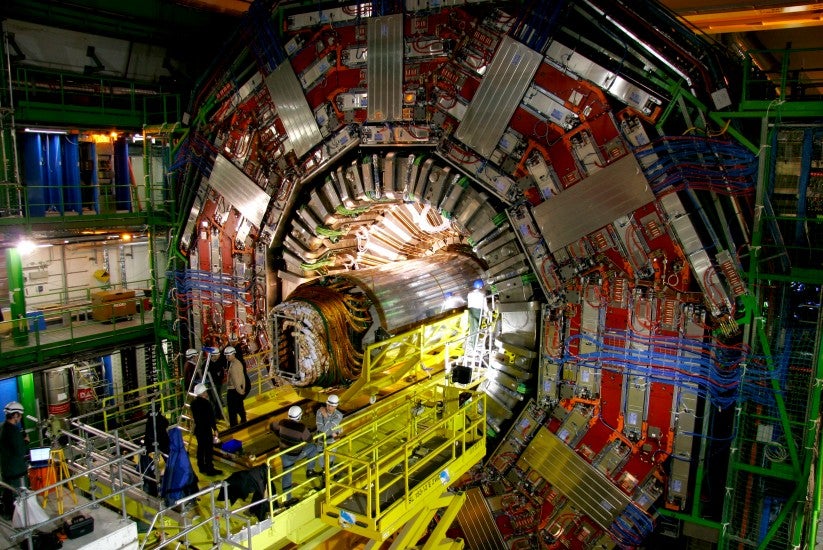
A research team led by QLab Fellow Shabnam Jabeen (UMD) and Professor Zhong-Bo Kang (UCLA) have trained quantum machine-learning models to recognize patterns in particle jets - the sprays of particles produced in high-energy collisions. Using simulated collision data, the team developed quantum graph neural networks and trained compact versions directly on IonQ trapped-ion and IBM Quantum superconducting processors. The study explores how quantum learning can be adapted to a demanding physics problem while identifying the information the models use to make their predictions.
Inferring particles from their tracks
Quarks and gluons produced in high-energy collisions cannot be observed as isolated particles in a detector. Instead, they initiate cascades that produce narrow sprays of particles called jets. Detectors record the resulting tracks and energy deposits, which physicists use to infer what started each cascade.
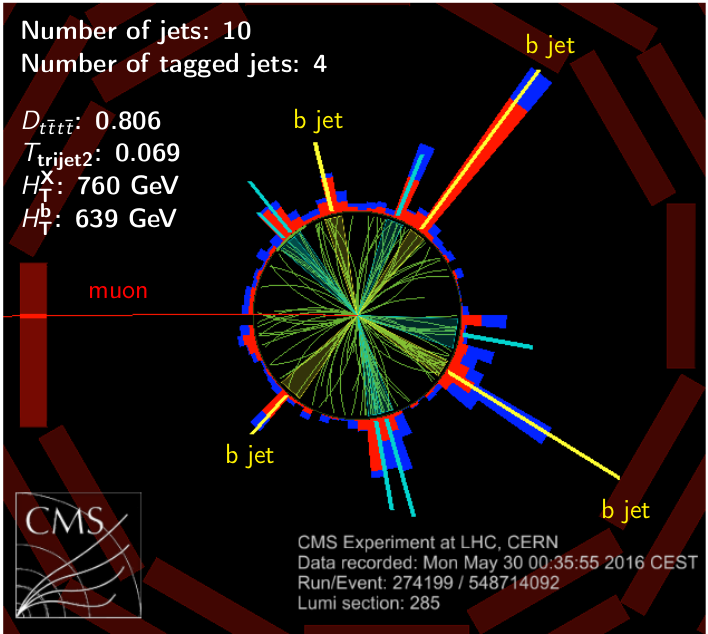
Identifying a jet’s origin, or “jet tagging,” helps distinguish interesting collision processes from more common backgrounds. Gluon jets typically contain more particles and spread their momentum more broadly than quark jets, but their patterns overlap. Recognizing these differences supports precision measurements, Higgs-boson studies, and searches for new particles.
The study also examines jets originating from up and down quarks. These quark varieties interact similarly through the strong force, making their jets difficult to distinguish through momentum patterns alone. Their different electric charges provide additional clues. Such flavor tagging could support the future Electron-Ion Collider’s investigations of proton structure, including how different quarks contribute to spin.
Representing jets with quantum graphs
The researchers represent each jet as a collection of particles, each described by features such as momentum, direction, and - in the flavor-tagging study—electric charge and particle identity. Their quantum graph neural network assigns one selected particle to each quantum bit, or qubit. Qubits form the nodes of a graph, while two-qubit operations provide connections between nodes.
To load the data, particle features are encoded in quantum-gate rotation angles. A useful input is the fractional transverse momentum, $z_i=p_{T,i}/p_{T,\mathrm{jet}}$, which compares a particle’s momentum perpendicular to the beam with that of the jet. Trainable weights adjust how strongly each feature enters the rotations. The circuit repeatedly encodes these features between layers of trainable quantum operations, a technique called data re-uploading. The study uses fully connected graphs, allowing every selected particle to participate in a two-qubit interaction with every other selected particle.
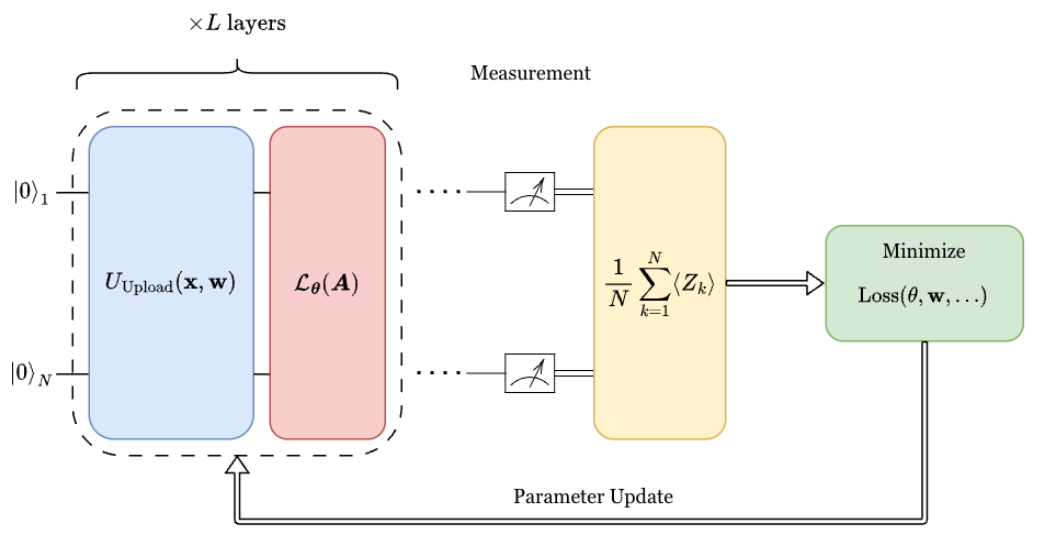
A central design principle is permutation invariance: changing the order in which the particles are listed should not change the model's prediction. To enforce this symmetry in the circuit, the network shares encoding weights across particles and uses the same node and edge parameters throughout each layer. Its pairwise gates are symmetric under exchange and commute with one another.
The final prediction also treats all nodes equally. The circuit produces the score $g=\frac{1}{N}\sum_{i=1}^{N}\langle Z_i\rangle$, where $N$ is the number of selected particles and $\langle Z_i\rangle$ is the average measurement outcome for qubit $i$, assigning values of $+1$ and $-1$ to its two computational-basis outcomes. A classical computer compares the scores with known jet labels and adjusts the encoding weights and gate parameters to improve classification.
Testing small models and interpreting their predictions
In noiseless simulations, five- and ten-qubit models performed comparably to the tested classical neural-network baseline. Their predictions correlated with physical properties: Momentum retained in selected constituents for quark-gluon tagging, and momentum-weighted particle charge for up-down tagging.
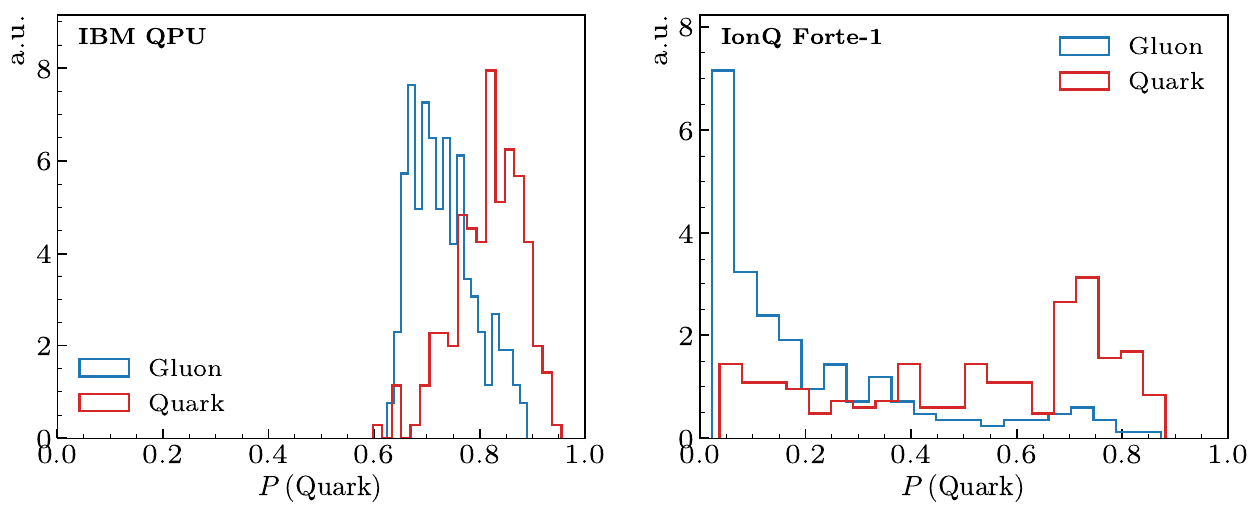
For hardware training and evaluation, the team used reduced models with two qubits for quark-gluon tagging and four qubits for up-down tagging, running on IBM superconducting and IonQ trapped-ion processors.
While the experiments remain small enough for straightforward classical simulation and do not establish a computational advantage over classical approaches, they demonstrate the quantum learning workflow and provide a concrete testbed for studying how model design, particle information, sampling, and hardware noise interact.
Research: Benjamin Jobilal, Jinghong Yang, Trevor Smith, Vincent Calvo, Zhong-Bo Kang, and Shabnam Jabeen, “Quantum Graph Neural Networks for Jet Tagging on Quantum Hardware,” arXiv:2609.04367 (2026).