
Highlights from QCaMP 2026: Empowering high school educators at QLab
This week, the National Quantum Laboratory (QLab) at UMD was thrilled to host a group of quantum-enthusiastic K-12 teachers for the 2026 Quantum Computing, Mathematics, and Physics (QCaMP) summer program. The STEM educators gathered at the UMD Physical Sciences Complex in College Park from June 22 to June 26 to dive into quantum information science and technology. The hybrid program in collaboration with the Quantum Systems Accelerator focused on giving teachers the tools, resources, and confidence to bring cutting-edge quantum concepts back to their classrooms.
A Comprehensive Quantum Curriculum
Over the course of the week, the educators engaged in a robust curriculum designed to build a strong foundation in quantum mechanics and computing, moving from fundamental concepts to advanced applications.
- Foundations of Quantum Science: Teachers explored the fundamental differences between classical bits and quantum qubits, alongside core quantum phenomena such as polarization and superposition.
 Entanglement & Hardware: The cohort learned about quantum entanglement and gained hands-on experience programming real quantum circuits using the IBM Quantum Composer.
- Advanced quantum technologies: The focus then shifted to the practical implementation of these concepts, including dedicated lessons on quantum key distribution (QKD) and various qubit technologies.
We extend our deepest gratitude to our partners at Sandia National Laboratories, Lawrence Berkeley National Lab, and the Quantum Systems Accelerator (QSA), as well as their expert instructors, for making QCaMP 2026 such a massive success.
Behind-the-Scenes at UMD
The week was packed with hands-on learning and exclusive visits to state-of-the-art quantum facilities of QLab and the Joint Quantum Institute (JQI) at UMD:
- Trapped-Ion Computing: QLab director Prof. Norbert Linke helped kick off the camp with an introductory session on ion-trap quantum computers, followed by a tour of the ion-trap quantum computing lab.
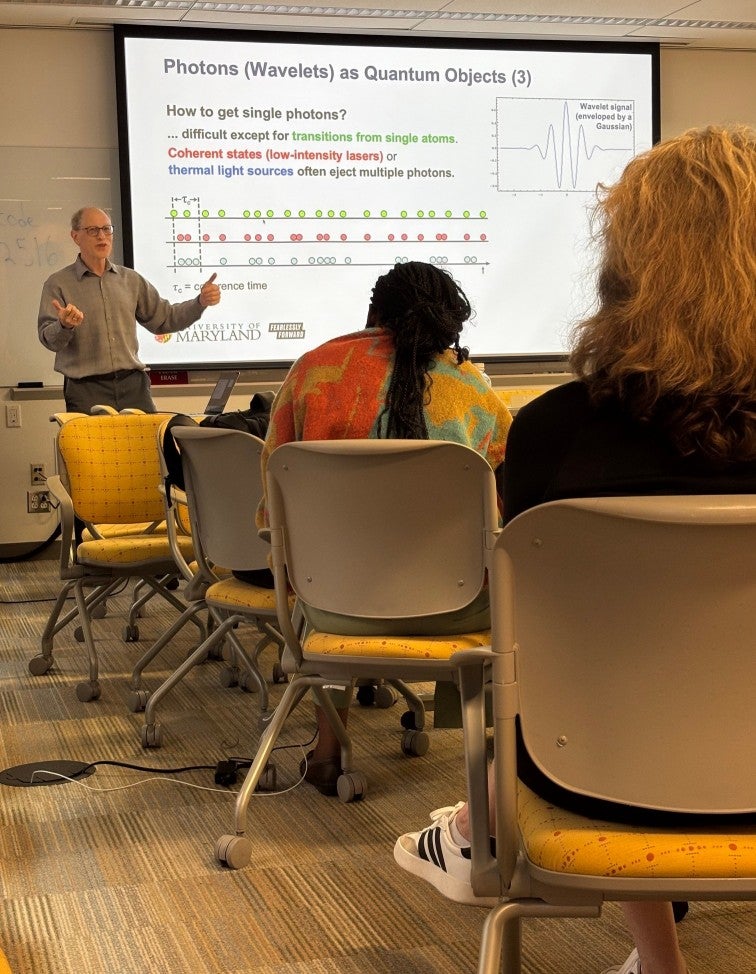
- Quantum Networking: On Thursday, QLab’s Dr. Franz Klein introduced the educators to the fundamental concepts of quantum networking, as seen in the picture, before leading an in-person tour of the quantum networking lab.
- Circuit QED: On Friday, participants wrapped up the week with a close-up look at highly controlled photonic quantum systems during a tour of Prof. Alicia Kollár’s circuit quantum-electrodynamics lab, led by Qianao Yue.
Professional Development Focus and Lesson Practice sessions
A massive thank you goes to our facilitator, Ryen Burris! Ryen is a Ph.D. student in UMD's Science Education Program, a graduate assistant in the Department of Teaching and Learning, Policy and Leadership, and a member of the Physics Education Research Group with experience in STEM education and outreach. Ryen expertly guided the daily Professional Development Focus and Lesson Practice sessions, helping the teachers to translate advanced physics into accessible, high school-ready lesson plans with hands-on activities.
Hands-On Quantum Kits for the Classroom
To ensure the educators can quickly translate these advanced topics into engaging student activities, each teacher was provided with a comprehensive physical learning kit for their classrooms. These fully equipped kits include:
- Polarizers and protractors for hands-on experiments demonstrating Malus’s law.
- Red, UV, and LED flashlights, alongside glow-in-the-dark stars, to help students visualize atomic qubits.
- Wooden squares and craft organizers for an interactive quantum-key-distribution demonstration.
- Printed logic gate cards for circuit puzzles.
- Tops and markers to demonstrate the superposition principle, and polyhedral dice for quantum dice games.
We can't wait to see how these teachers inspire the next generation of quantum scientists!
Local organizers: Dr. Thomas Barthel and Dr. Norbert Linke.