
News
-
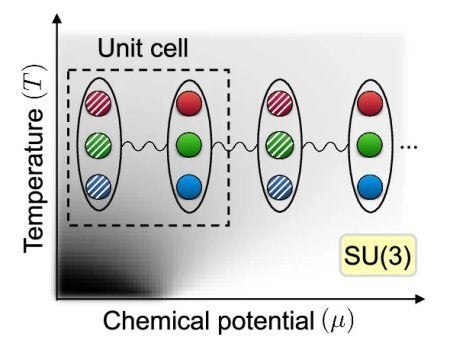 Quantum chromodynamics (QCD) is the fundamental theory for how quarks and gluons interact through the strong nuclear force. In their recent paper "The phase diagram of quantum chromodynamics in one dimension on a quantum computer", QLab researchers Alaina Green and Norbert Linke, their team, and collaborators from the University of Waterloo and York University show a fascinating path for the simulation of QCD at finite temperatures on quantum computers. The study has been published in Nature Communications.
 -
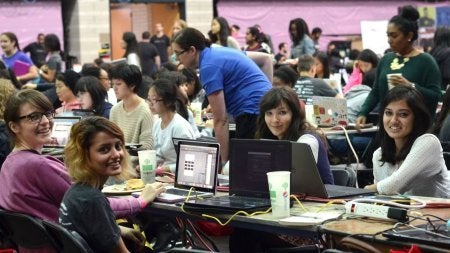 At the Technica 2025 conference, hackers also dived into the world of quantum physics. The workshop "Introduction to Quantum Computation", held by QLab's Thomas Barthel, introduced the paradigm-shifting potential of quantum technology covering: the superposition principle, quantum circuits and universal gate sets, quantum algorithms promising a polynomial or even exponential quantum speedup, an overview of the different quantum computing platforms, decoherence, and quantum error correction.
 -
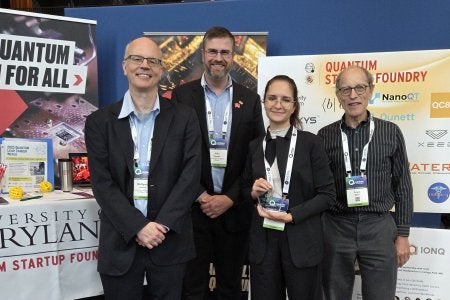 EPFL Neuro-X master's students Maria Yuffa and Arash Sal Moslehian have won the NeuroQuantum Nexus prize at the Connected DMV's Global Industry Challenge, a program of the UN's International Year of Quantum Science and Technology. The duo used a combination of classical and quantum computing to analyze neural network data. Their winning project explored how both functional connections and anatomical structure contribute to auditory processing.
 -
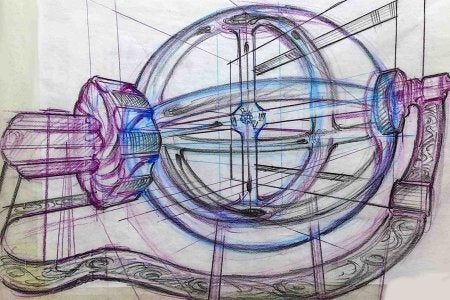 QLab contributes with experiments to the Maryland Quantum-Thermodynamics Hub, leveraging a recent $5 million funding boost to explore the intersection of quantum information, fundamental physics, and thermodynamics. Alaina Greene and Norbert Linke will lead cutting-edge trapped-ion experiments to test the Hub's theoretical predictions in real-world quantum environments.
 -
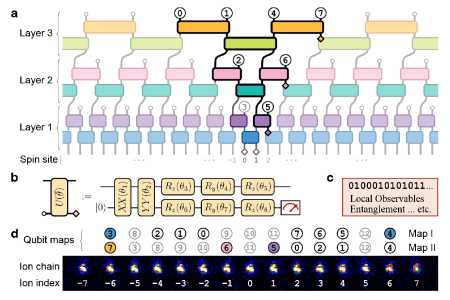 In the JQI seminar at UMD, QLab's Dr. Barthel presented a new approach to simulate strongly-correlated quantum matter efficiently on quantum computers using entanglement renormalization—a method that leverages a clever parametrization of quantum many-body states in terms of hierarchical MERA tensor networks. First experiments on ion-trap devices, clearly demonstrate a continuous quantum phase transition, and a new holographic tomography scheme made it possible to resolve, for the first time, the transition from area-law to log-area law scaling of groundstate entanglement entropies when approaching criticality.
 -
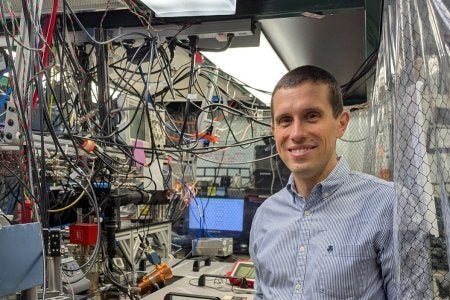 Excited to start a new chapter for QLab. Norbert Linke takes over as the new Director, working to make quantum technology accessible for researchers, entrepreneurs, and educators. QLab - Quantum for all!
 -
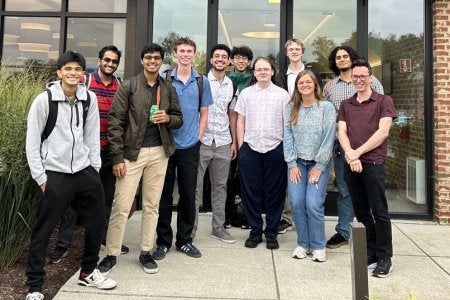 Under the guidance of Dr. Franz Klein, 12 students from UMD and UDC spent seven weeks working on a variety of quantum computing projects. The projects included applying quantum cellular automata to neuron data, using quantum circuits for image processing, solving routing problems with quantum algorithms like VQE and QAOA, and exploring quantum games. The internship gave students hands-on experience with real quantum hardware and software.
 -
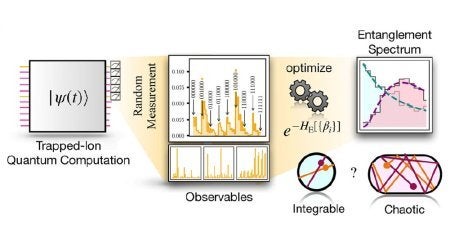 In their study "Quantum computing universal thermalization dynamics in a (2+1)D lattice gauge theory", Niklas Mueller, Tianyi Wang, Or Katz, Zohreh Davoudi, and Marko Cetina leveraged a cutting-edge ion-trap quantum computer to experimentally probe the complex process of thermalization in a lattice gauge theory. The analysis focuses on the entanglement spectrum of the strongly-correlated quantum many-body system.
 -
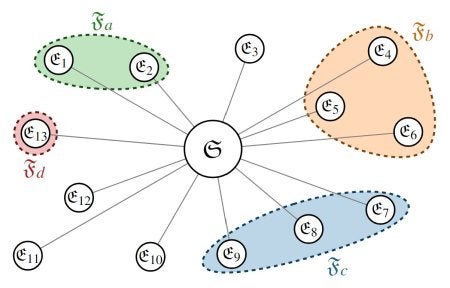 The study, "Classifying two-body Hamiltonians for Quantum Darwinism" by Doucet and Deffner analyzes criteria under which system-environment interactions lead to quantum Darwinism—the process by which an objective, classical reality emerges through the environment's redundant encoding of a quantum system's information. Theoretical arguments and numerical simulations suggest that classical objectivity, where multiple observers can agree on a system's state, is the rule in the quantum world, not the exception.