
Research
QLab supports interdisciplinary research that brings quantum computing hardware together with domain expertise. Across science and engineering, researchers use QLab systems to develop and test algorithms, investigate quantum matter, build networking and control technologies, and measure the capabilities of emerging quantum processors.
- Quantum Machine Learning
Quantum machine learning combines quantum circuits with classical optimization to explore new approaches to classification, materials discovery, and quantum-state reconstruction. QLab researchers test these methods on real processors, where noise, limited data, and hardware constraints reveal both the promise and the practical limits of near-term quantum learning.
Selected recent papers
Jobilal et al., Quantum graph neural networks for jet tagging on quantum hardware, arXiv:2609.04367 (2026).
Adams et al., Quantum kernel machine learning for autonomous materials science, arXiv:2601.11775 (2026).
Lakhdar-Hamina et al., Benchmarking a tunable quantum neural network on trapped-Ion and superconducting hardware, arXiv:2507.21222 (2025). - Quantum Simulation of Matter and Fields
Quantum computers can emulate strongly correlated quantum many-body systems whose state spaces overwhelm classical computation. For the investigation of condensed matter, particle, and nuclear physics, QLab research combines compact encodings, tensor-network ideas, and tailored measurement protocols to study phase transitions, entanglement, gauge dynamics, and even toy models of emergent spacetime.
Selected recent papers
Biswas et al., Observation of gravity-like signatures in holographic codes on a quantum computer, arXiv:2607.12047 (2026).
Miao et al., Probing entanglement scaling across a quantum phase transition on a quantum computer, Nature Communications 17, 9110 (2026).
Than et al., The phase diagram of quantum chromodynamics in one dimension on a quantum computer, Nature Communications 16, 10288 (2025).
Than et al., Observation of quantum-field-theory dynamics on a spin-phonon quantum computer, arXiv:2509.11477 (2025).
Davoudi et al., Quantum computation of hadron scattering in a lattice gauge theory, arXiv:2505.20408 (2025). - Quantum Algorithms and Error Correction
Quantum algorithms seek computational advantages by matching a problem's structure to operations that quantum hardware can perform more efficiently than any classical computer. In cases like Shor's algorithm for prime factorization, this can lead to gains that grow exponentially in the problem size. This generally requires error correction which protects the information needed for long computations. QLab research develops algorithms, reduces resource demands, and studies thresholds and nonclassical resources that determine when quantum computations are useful.
Selected recent papers
Yang et al., Towards end-to-end quantum estimation of non-Hermitian pseudospectra, arXiv:2603.16214 (2026).
Li et al., Resource-efficient quantum simulation of transport phenomena via Hamiltonian embedding, arXiv:2602.03099 (2026).
Niroula et al., Phase transition in magic with random quantum circuits, Nature Physics 20, 1786 (2024). - Quantum Networking and Communications
Quantum networks distribute entanglement between remote quantum memories, processors, and sensors using photons. Our research focuses on robust photonic interfaces and compatibility with deployed telecommunications fiber, opening paths toward modular quantum computers and quantum-enhanced network security.
Selected recent papers
Wu et al., Trapped ion quantum networking and telecommunications coexisting on one fiber, arXiv:2609.06387 (2026).
Kao et al., Quantum-enhanced physical-layer threat detection in metropolitan-scale fiber networks, arXiv:2607.10799 (2026).
Ferrari et al., Robust ion-photon entanglement via polarization-to-time-bin conversion, arXiv:2607.07805 (2026). - Quantum Hardware Control and Enabling Technologies
Useful quantum computation depends on more than qubit count: gates must be fast and calibratable, control systems must be safe, and quantum information must move reliably between hardware components. QLab researchers co-design experimental methods and software interfaces that improve performance today and support more scalable architectures.
Selected recent papers
Wang et al., A hardware-safety-gated system for LLM-written native ARTIQ control code on a trapped-ion platform, arXiv:2606.27231 (2026).
Diaz et al., Arbitrary parallel entangling gates with independent calibration on a trapped ion quantum computer, arXiv:2604.25993 (2026). - Device Characterization and Benchmarking
QLab provides access to quantum computers based on different technologies including trapped ions, superconducting qubits, and netural atoms in optical tweezer arrays. To use them efficiently and guide hardware developments, QLab research analyzes the application-dependent performance of these devices and implements efficient error mitigation schemes.
Selected recent papers
Than et al., Nonlocal games as cross-platform quantum benchmarks: Exceeding unconditional classical bounds on trapped-ion processors, arXiv:2603.18323 (2026).
Doucet et al., From compatibility of measurements to exploring Quantum Darwinism on NISQ, arXiv:2601.05350 (2026).
Proctor et al., Featuremetric benchmarking: Quantum computer benchmarks based on circuit features, arXiv:2504.12575 (2025).
Recent Projects
-
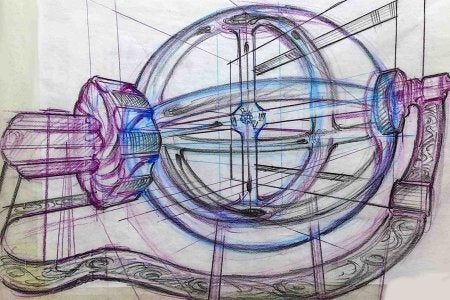 QLab contributes with experiments to the Maryland Quantum-Thermodynamics Hub, leveraging a recent $5 million funding boost to explore the intersection of quantum information, fundamental physics, and thermodynamics. Alaina Greene and Norbert Linke will lead cutting-edge trapped-ion experiments to test the Hub's theoretical predictions in real-world quantum environments.
 -
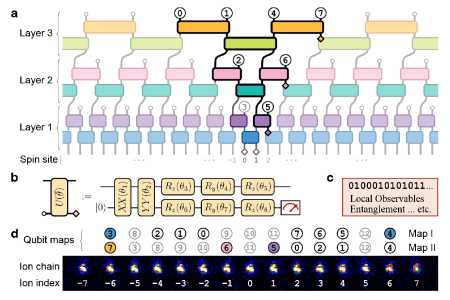 In the JQI seminar at UMD, QLab's Dr. Barthel presented a new approach to simulate strongly-correlated quantum matter efficiently on quantum computers using entanglement renormalization—a method that leverages a clever parametrization of quantum many-body states in terms of hierarchical MERA tensor networks. First experiments on ion-trap devices, clearly demonstrate a continuous quantum phase transition, and a new holographic tomography scheme made it possible to resolve, for the first time, the transition from area-law to log-area law scaling of groundstate entanglement entropies when approaching criticality.
 -
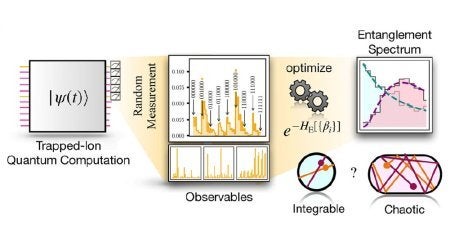 In their study "Quantum computing universal thermalization dynamics in a (2+1)D lattice gauge theory", Niklas Mueller, Tianyi Wang, Or Katz, Zohreh Davoudi, and Marko Cetina leveraged a cutting-edge ion-trap quantum computer to experimentally probe the complex process of thermalization in a lattice gauge theory. The analysis focuses on the entanglement spectrum of the strongly-correlated quantum many-body system.
 -
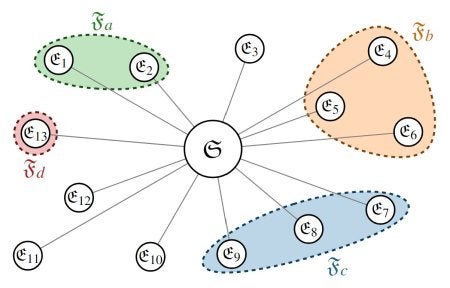 The study, "Classifying two-body Hamiltonians for Quantum Darwinism" by Doucet and Deffner analyzes criteria under which system-environment interactions lead to quantum Darwinism—the process by which an objective, classical reality emerges through the environment's redundant encoding of a quantum system's information. Theoretical arguments and numerical simulations suggest that classical objectivity, where multiple observers can agree on a system's state, is the rule in the quantum world, not the exception.